The static IP that doesn’t break when your ISP does
Ask any IT manager what happens when their primary internet provider goes down, and you’ll usually hear the same reassuring answer: “We have a second ISP.” It sounds like resilience. In practice, for anything that depends on a fixed IP address, it often isn’t resilience at all.
Here’s the gap that catches organisations out, and how to close it for good.
Why a second ISP doesn’t protect your IP
A static IP is not really “yours.” It’s borrowed from your ISP’s larger pool of addresses, and it only works because that ISP tells the internet where to find it. When you add a second provider for redundancy, they hand you a completely different block of addresses that works only over their link.
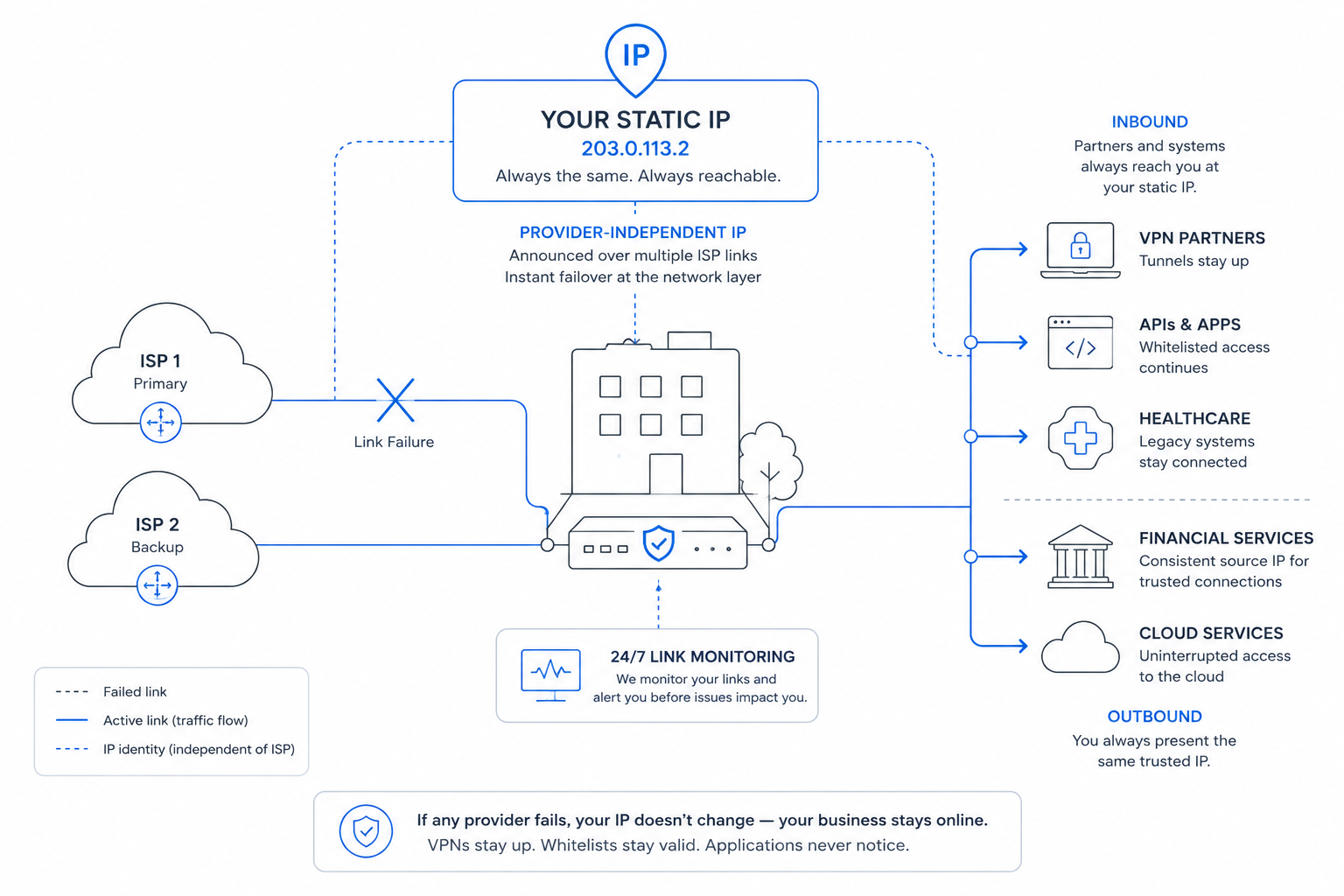
So when your primary ISP fails, your traffic can technically still reach the internet over the backup, but your static IP is gone. And a surprising amount of business-critical infrastructure is quietly bolted to that specific address:
- VPN tunnels to vendors and partners, built to your fixed IP.
- APIs and applications that only accept connections from a whitelisted source IP.
- Legacy systems, healthcare interfaces, industrial controllers, ATMs, cameras, that only understand static addresses.
When the primary link drops, none of these fail over. Someone has to manually rebuild every VPN tunnel and re-whitelist every address on the backup ISP’s IP, usually in the middle of the outage, on the phone to a dozen vendors, while the business waits. We’ve seen organizations left completely offline because the backup had quietly failed months earlier and nobody noticed until the primary went too.
The real fix: make the IP belong to you, not the ISP
That’s exactly what a provider-independent static IP delivers. Your address is announced across two or more ISP links at once, from a carrier-grade network. If any provider fails, the address doesn’t move, traffic simply keeps flowing over a surviving link. Your VPNs stay up. Your whitelisted connections keep working. Your applications never notice anything happened.
And it protects both directions:
- Inbound: partners and systems always reach you at the same fixed address, no matter which link is carrying the traffic.
- Outbound: you can present one consistent, trusted source IP to vendors who lock down access by address, even though your packets may be leaving over different providers.
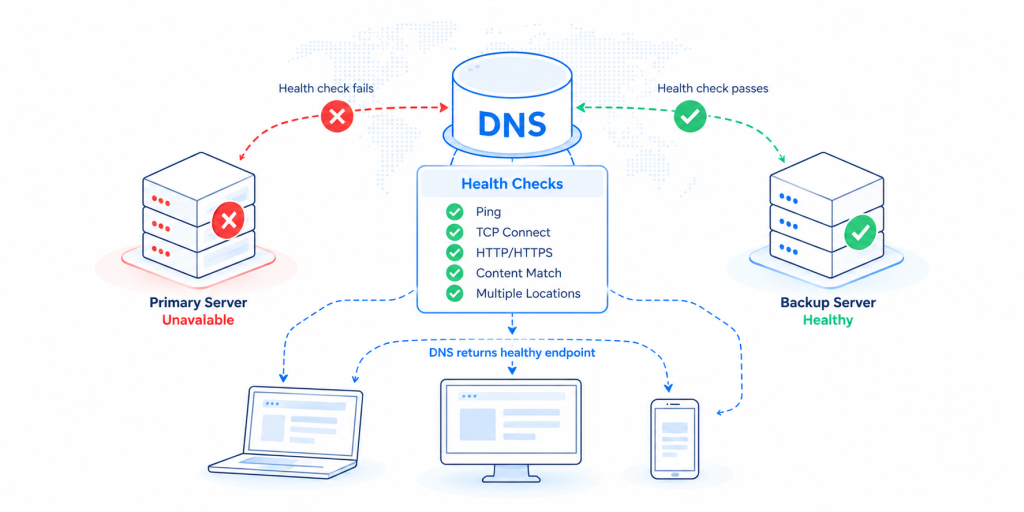
Why it fails over in seconds, not minutes
What about the complexity?
The traditional way to achieve a provider-independent IP is heavy: you’d need your own block of address space, your own network identity, BGP-capable links from multiple ISPs, redundant routers and someone on staff who genuinely understands BGP routing. For most organisations that’s neither practical nor affordable.
The managed version removes all of it. The provider supplies the address space and network identity, builds the redundant connections into your site, and runs the routing. Most existing firewalls and routers already support what’s needed, and if you’d rather not touch any of it, a managed appliance can sit on your premises and handle the whole thing. Day to day, there’s almost nothing to manage, the failover happens on its own. The one thing worth watching is whether a link has silently failed, and good providers monitor that for you and raise the alarm before a redundant setup quietly becomes a single point of failure.
Who needs this most
- Healthcare providers running VPNs and legacy interfaces to a web of vendors.
- Financial services firms with partner integrations and disaster-recovery obligations.
- Multi-site operators: retail, hospitality, gaming, where every location needs a reliable static IP for payments, security systems and monitoring.
- Public sector and regulated bodies expected to maintain enterprise-grade resilience, often without enterprise-grade networking teams.
The bottom line
Curious whether your setup has this gap? Talk to one of our engineers — we’ll walk through your current failover and show you what a provider-independent static IP would change.