Application Traffic Management

Application Traffic Management built for availability.

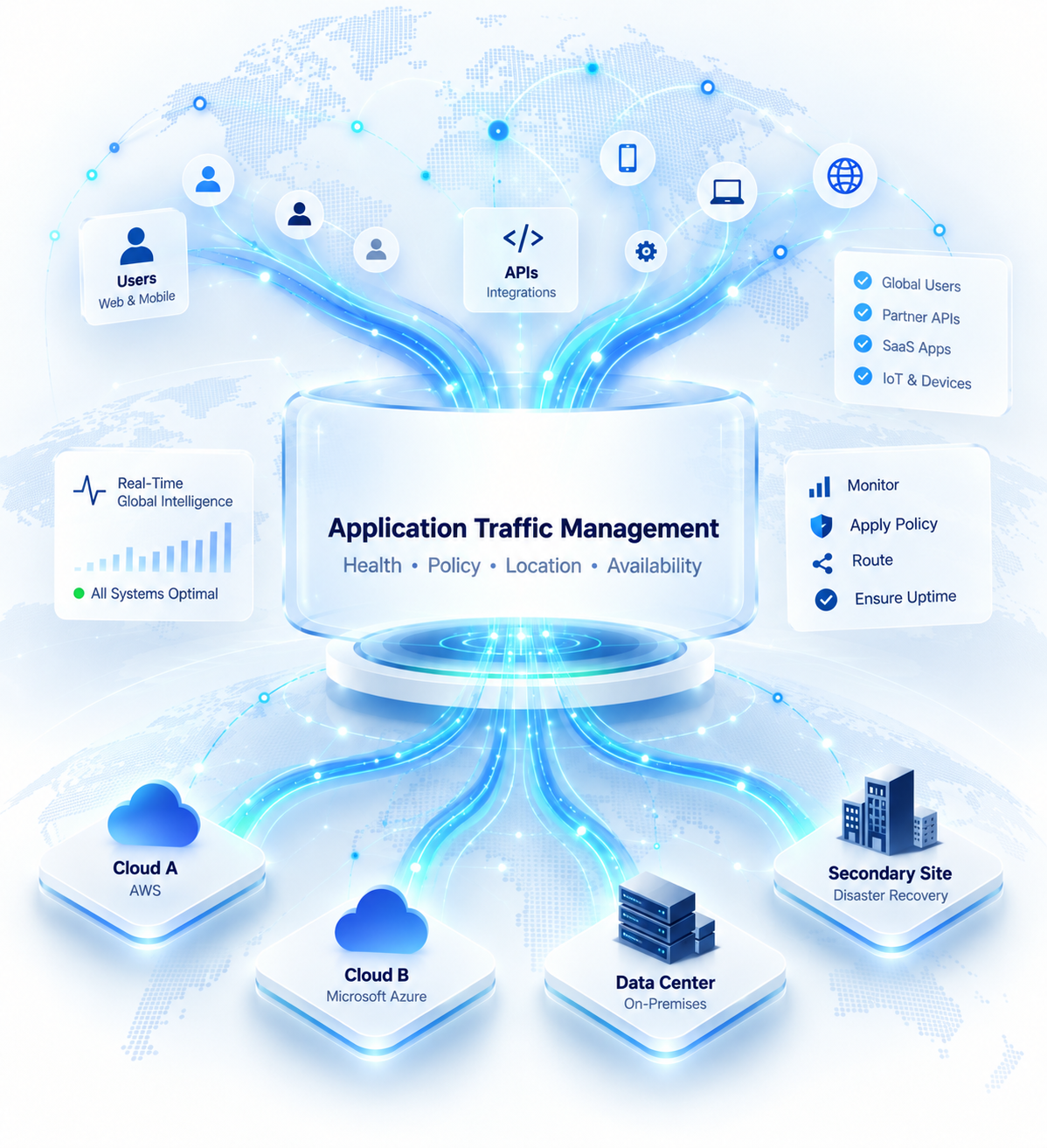
Control how users and requests reach your applications across servers, sites, regions and clouds.  Use application health, routing policies, location and availability to direct traffic toward the right infrastructure and move it elsewhere when conditions change.

Health-Aware Routing

Policy-Based Control

Multi-Site & Multi-Cloud

Application Traffic Management Network

Control how traffic reaches your applications

Application traffic management is the process of deciding how incoming application traffic should be distributed and routed across available infrastructure.  Instead of simply sending traffic to a fixed destination, traffic management can consider factors such as application health, capacity, location, routing policy and infrastructure availability before deciding where a request should go.  If an application endpoint, server, site or cloud environment becomes unavailable, traffic can be redirected toward healthy infrastructure rather than leaving users dependent on a failed resource.  Application traffic management can operate at several levels, combining technologies such as load balancing, global server load balancing, DNS traffic management, health monitoring and automated failover as part of a wider Application Delivery strategy.


Traffic should follow application health, not infrastructure assumptions.

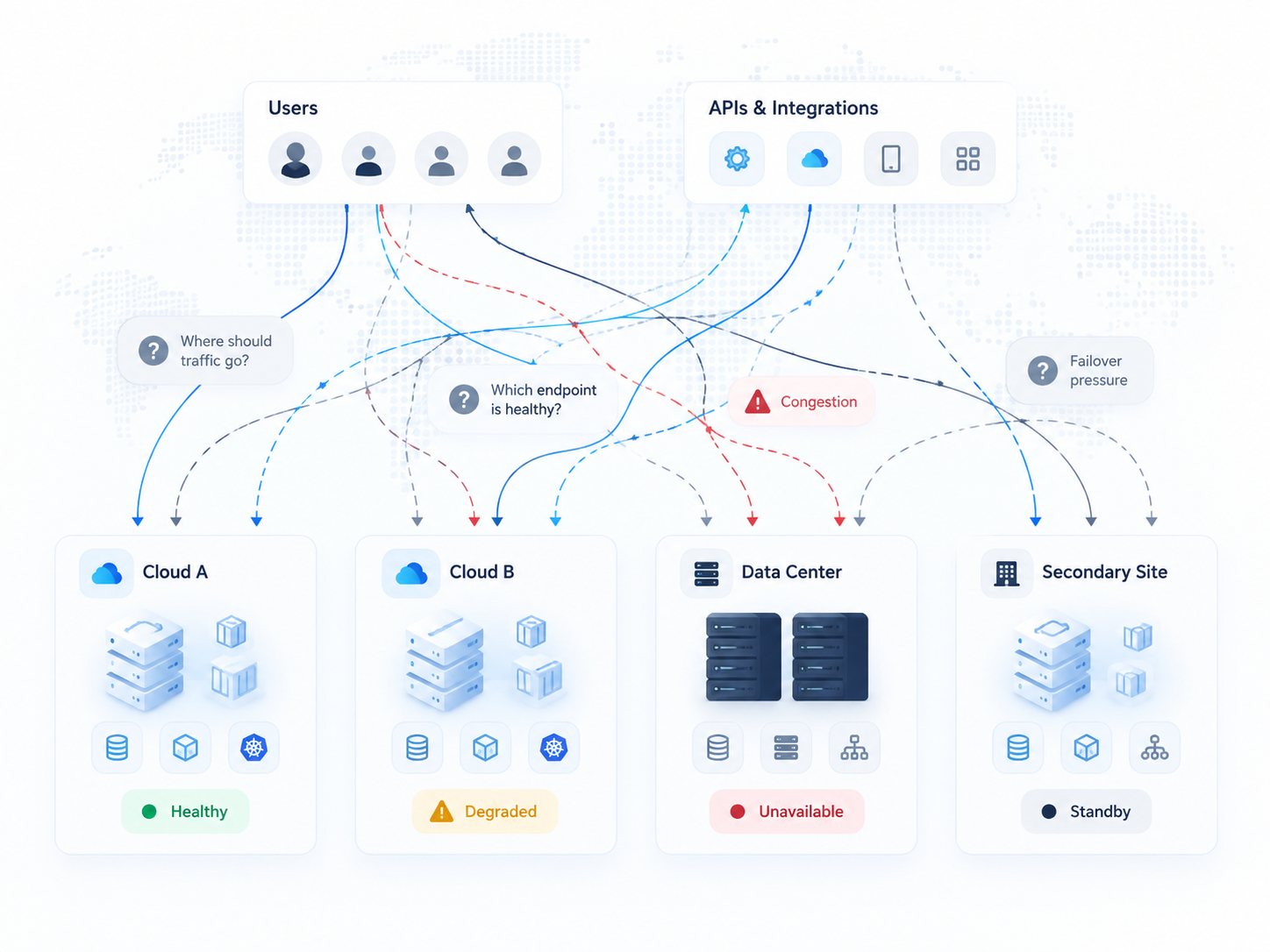
Applications rarely live on a single server anymore.  They may span multiple servers, availability zones, data centers, cloud platforms or geographic regions. Yet simply deploying infrastructure in more than one location does not automatically make an application highly available.

You also need a reliable way to decide:

  • – Which application endpoint should receive traffic?
  • – Is that endpoint actually healthy?
  • – Should users be sent to the closest location?
  • – Should traffic be distributed evenly or according to policy?
  • – What happens when a server, site, network or provider becomes unavailable?
  • – How quickly can traffic be moved somewhere else?
  •  

This is where application traffic management becomes part of the availability architecture.  Total Uptime can monitor application infrastructure and direct traffic toward healthy resources when individual endpoints or locations become unavailable.

IT Infrastructure Routing Complexity

From application request to healthy endpoint.

Monitor

Total Uptime monitors the application endpoints, servers or locations that form part of the delivery architecture.

Evaluate

Traffic decisions can take account of application health, routing rules, availability, location and other defined policies.

Route

Requests are directed toward the appropriate healthy application infrastructure.

Re-route

If conditions change or an endpoint becomes unavailable, traffic can be moved toward alternative infrastructure according to the routing configuration.

Route application traffic based on what is happening now

Health-Based Routing

Continuously evaluate the availability of applications and infrastructure, then direct traffic toward endpoints that are responding as expected.

Policy-Based Routing

Define how traffic should be handled according to your application requirements, rather than relying entirely on the routing logic of an individual cloud or infrastructure provider.

Location-Aware Routing

Direct users toward appropriate application locations based on geography, proximity or the architecture of your service.

Intelligent Load Distribution

Spread traffic across multiple application resources to reduce reliance on individual servers and make better use of available infrastructure.

Automated Failover

When a monitored endpoint or location becomes unavailable, redirect traffic toward alternative healthy infrastructure according to predefined rules.

Multi-Cloud & Hybrid Traffic Steering

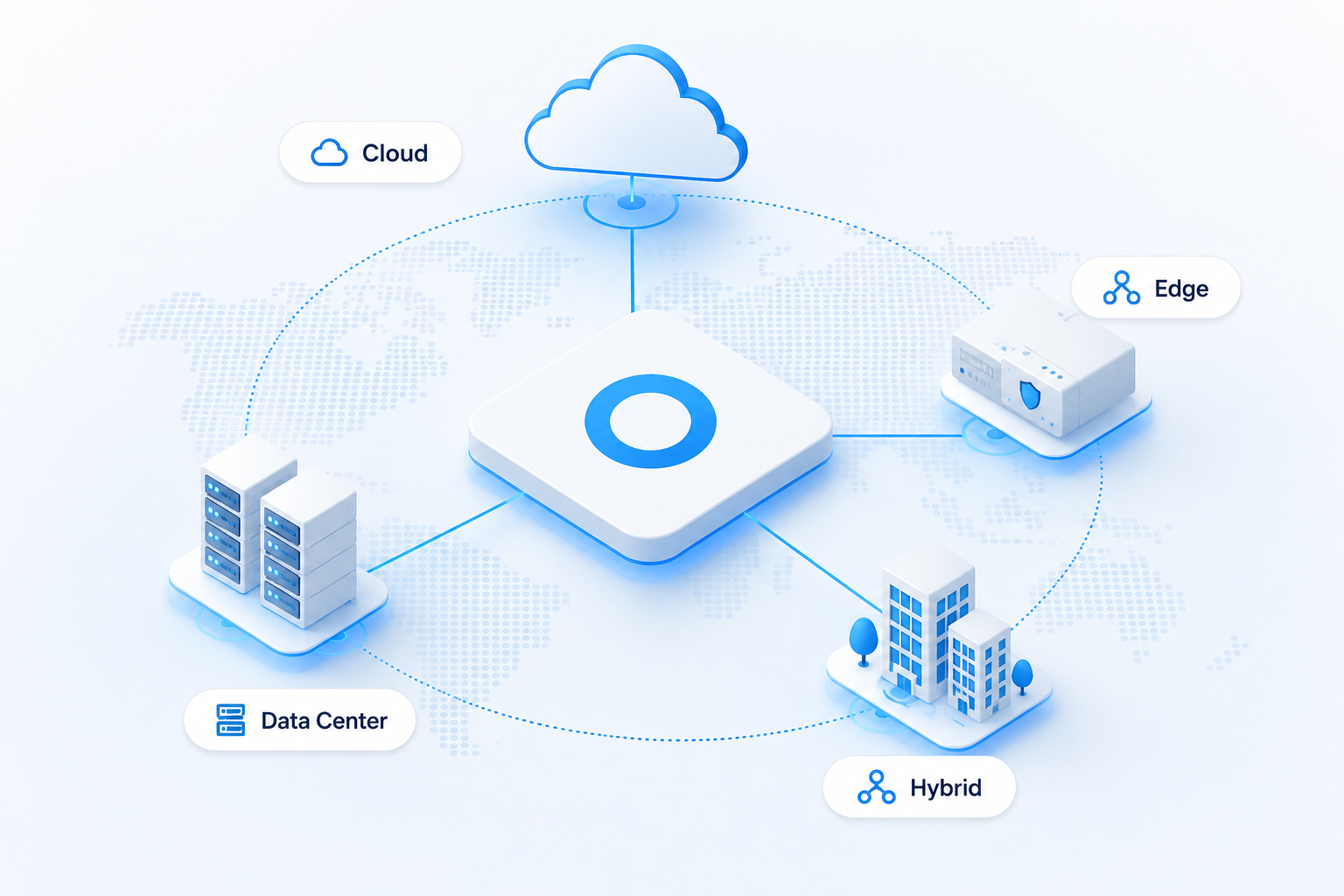
Manage application traffic across cloud platforms, private infrastructure, data centers and distributed environments without requiring every application to run in the same place.

Manage traffic your way

Applications do not all run in the same environment, so traffic management should not force them to.

Managed Cloud

Let Total Uptime operate the application delivery infrastructure while you control how traffic should be distributed.

Self Hosted

Deploy traffic management and application delivery within your own data center, private cloud or public cloud environment.

Hybrid

Combine managed and self-hosted capabilities where applications span different infrastructure environments.

Critical Application Delivery

Is Application Traffic Management the same as Load Balancing?

Not quite.  Load balancing is one part of application traffic management.

It can include:

A load balancer typically distributes incoming requests across multiple servers or application endpoints. Application traffic management is the broader strategy for determining how traffic should move across servers, sites, regions, cloud providers and application environments.

Where Application Traffic Management makes a difference.

High Availability

Reduce dependency on individual application endpoints by directing traffic toward healthy infrastructure.

Cloud & Provider Failover

Build alternative application paths so a problem with one cloud, provider or location does not automatically become an application outage.

Multi-Region Applications

Distribute traffic between application environments running in different geographic regions.

Disaster Recovery

Route users toward secondary infrastructure when the primary application environment becomes unavailable.

Application Scaling

Distribute increasing application and API traffic across multiple resources instead of allowing a single endpoint to become the bottleneck.

Planned Maintenance & Migration

Move application traffic between infrastructure environments while servers, locations or platforms are being changed or maintained.

Traffic Management built around application availability

Infrastructure Independence

Design traffic paths around the application rather than depending entirely on a single cloud platform or infrastructure provider.

Application Health Matters

Route traffic according to whether application infrastructure is actually available, not simply whether it exists.

Managed and Self-Hosted

Use Total Uptime as a managed service, deploy within infrastructure you control, or combine the two.

More Than Traffic Distribution

Bring load balancing, DNS, GSLB, traffic management, connectivity and application security into the same wider Application Delivery strategy.

Frequently asked questions

Quick answers to the questions infrastructure teams ask most.

What is application traffic management?

Application traffic management controls how requests are distributed and routed across the infrastructure running an application. Routing decisions can consider factors such as endpoint health, availability, location, capacity and defined traffic policies.

Application traffic routing is the process of directing application requests toward a particular server, endpoint, location or cloud environment. Intelligent routing can change the destination when application conditions change.

Load balancing normally distributes traffic across a group of servers or endpoints. Application traffic management is broader and can control traffic across servers, data centers, geographic regions and cloud providers using load balancing, DNS, GSLB, health monitoring and failover.

Yes. Health checks can monitor application endpoints and allow traffic to be directed away from infrastructure that is unavailable or not responding according to defined criteria.

Yes. Traffic management can be used to direct requests across application infrastructure hosted in different cloud providers, regions, private infrastructure and data centers.

Where failover has been configured, the failed endpoint can be removed from the available traffic path and requests can be redirected toward alternative healthy infrastructure.

Customer success

Trusted by IT Teams Worldwide

Real organisations. Real resilience. Real results.

Rated by the people who use us.

Make Traffic Routing Part of Your Availability Strategy

Your application may run across multiple servers, sites or clouds. The important question is what happens to traffic when one of them stops working.  Total Uptime can help you design an application traffic management architecture that routes users toward healthy infrastructure and keeps applications available when conditions change.