Latest

Total Uptime®

Blogs

Global Server Load Balancing Without Appliances

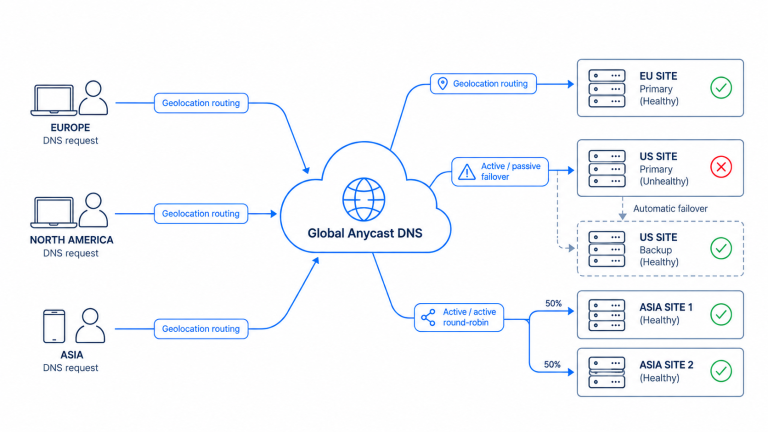
GSLB Without Appliances: Global Server Load Balancing as a Service If you manage infrastructure across multiple locations, whether that’s two data centers, a primary cloud region with a disaster recovery site, or a network of retail and branch locations, you’ve probably encountered the challenge of keeping applications available when something goes wrong. Global server load […]

Greg Howett
Blogs · Outages

NetScaler vulnerabilities

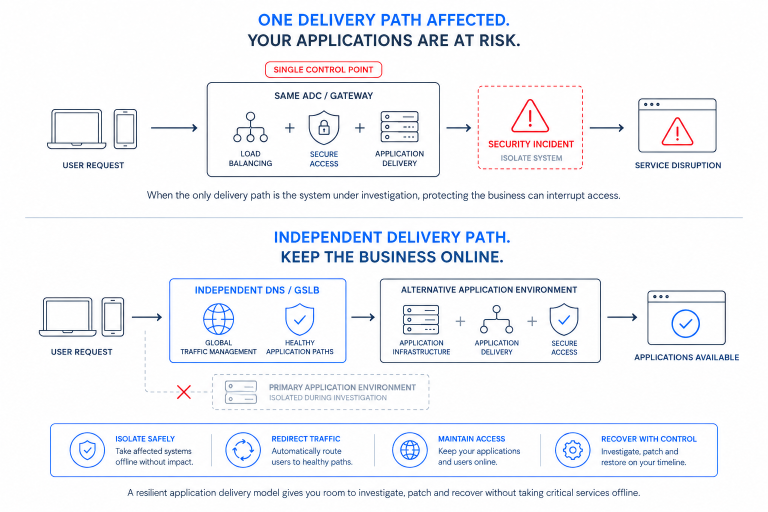
NetScaler Zero-Days: Can Your Applications Stay Online During a Security Incident? A critical security alert arrives, and your team needs to act. The affected system may need to be isolated, investigated and updated before it can safely return to service. The difficulty is that this same system sits between your users and the applications they […]

Nadet Rautenbach

Blogs · Cloud DNS

DNS failover explained

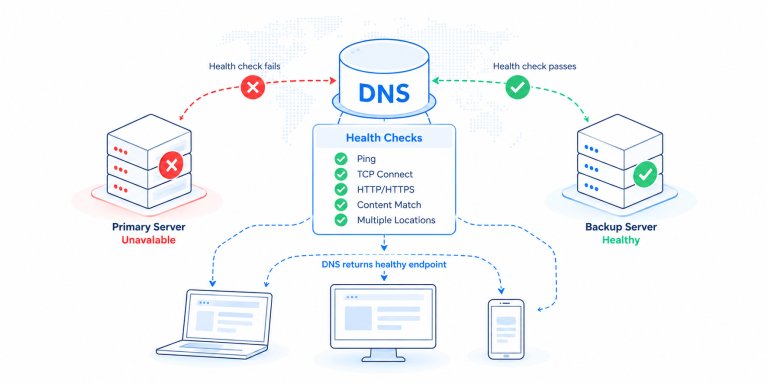
DNS Failover Explained: From Health Checks to Hands-Free Automation If your primary server, data center, or cloud region goes down at 3 a.m., how long does it take for traffic to move somewhere healthy, and who needs to be awake to make it happen? For many teams, the answer still involves a pager, a VPN […]

Greg Howett

Blogs

SOC 2 Type 2 and Operational Resilience

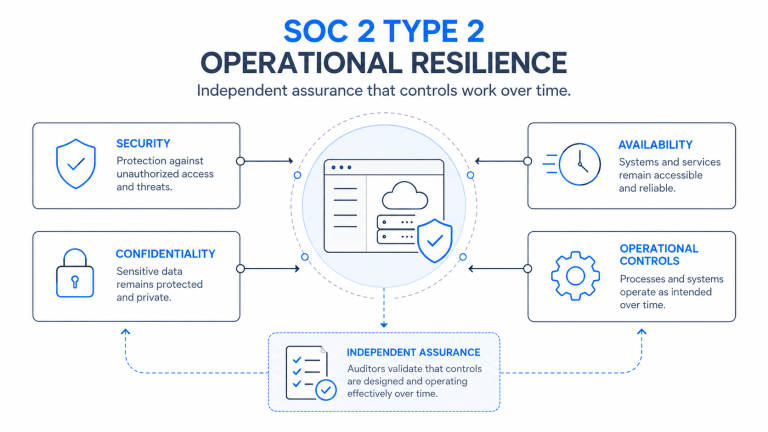
SOC 2 Type 2 and Operational Resilience: Why Independent Assurance Matters Every infrastructure provider can say its platform is secure, resilient, and ready for the enterprise. The harder question is whether the controls behind those claims have been independently examined and shown to work consistently over time. For organizations running payment systems, customer-facing applications, regulated […]

Marco Essomba

ADCaaS / Load Balancing · Blogs · Load Balancing

What Is Load Balancing & Do You Need It?

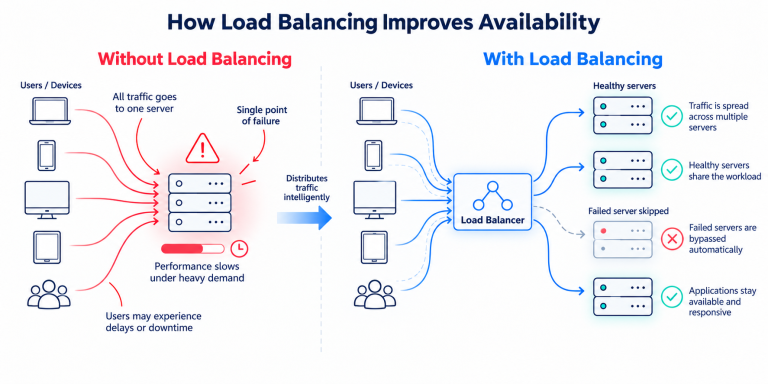
What Is Load Balancing, and Do I Need It? Most people never think about load balancing until something stops working. A website becomes painfully slow during a traffic spike. An application server fails and suddenly nobody can log in. A planned maintenance window turns into an outage because there is nowhere else to send users. […]

Nadet Rautenbach

Blogs · Cloud DNS

Why your DNS shouldn’t live inside your cloud provider

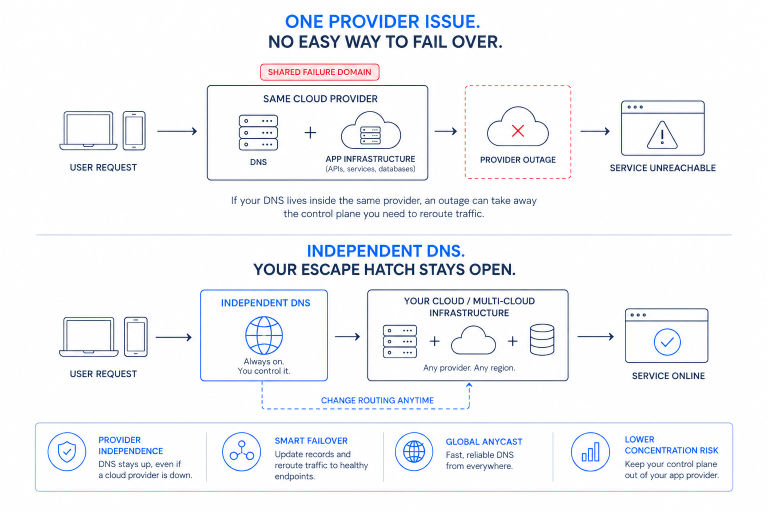
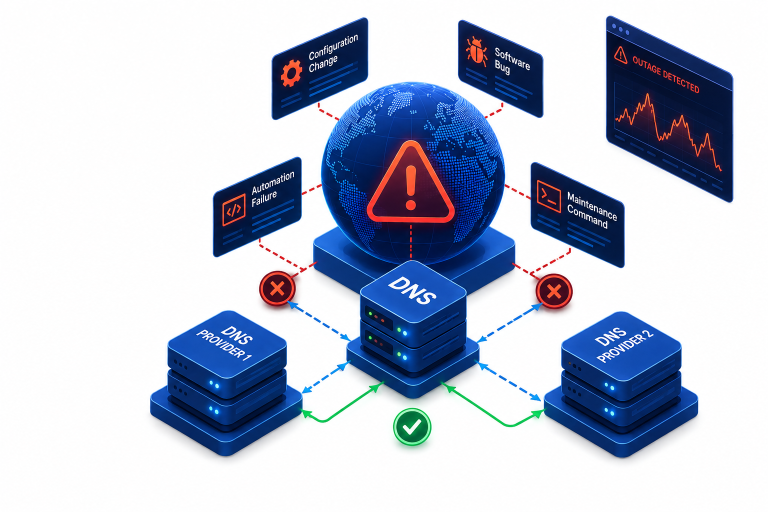
Why your DNS shouldn’t live inside your cloud provider On October 19 and 20, 2025, AWS ran into the kind of failure that is easy to assume only happens somewhere else. A latent race condition inside AWS’s own DNS automation wrote an empty DNS record for the DynamoDB endpoint in us-east-1. DynamoDB itself was healthy, […]

Greg Howett

Blogs · Cloud DNS

Free DNS vs Managed DNS

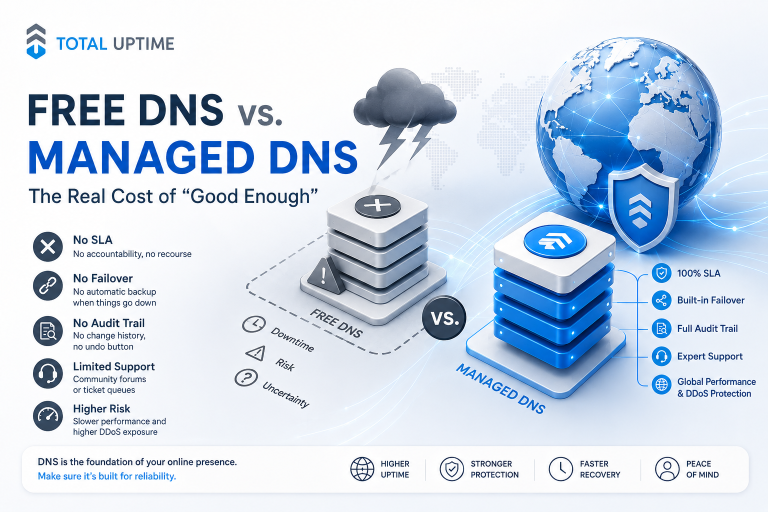
Free DNS vs. Managed DNS: The Real Cost of “Good Enough” If your DNS came bundled with your domain registration, or you pointed your nameservers at Cloudflare’s free plan years ago and haven’t thought much about it since, you’re certainly not alone. For many small and mid-sized businesses, DNS feels like a problem that has […]

Nadet Rautenbach

Blogs · Cloud DNS · Outages

Biggest DNS Outages: Real Root Causes & Prevention

The World’s Biggest DNS Outages: What Actually Caused Them and How to Avoid Being Next   When a major online service suddenly disappears, the first assumption is often that someone is attacking it. Sometimes that is exactly what happened. The Dyn outage in 2016 is a good example. But look at the post-mortems from some […]

Greg Howett

Blogs · Cloud DNS

Why DNS is the most underestimated single point of failure in your Infrastructure

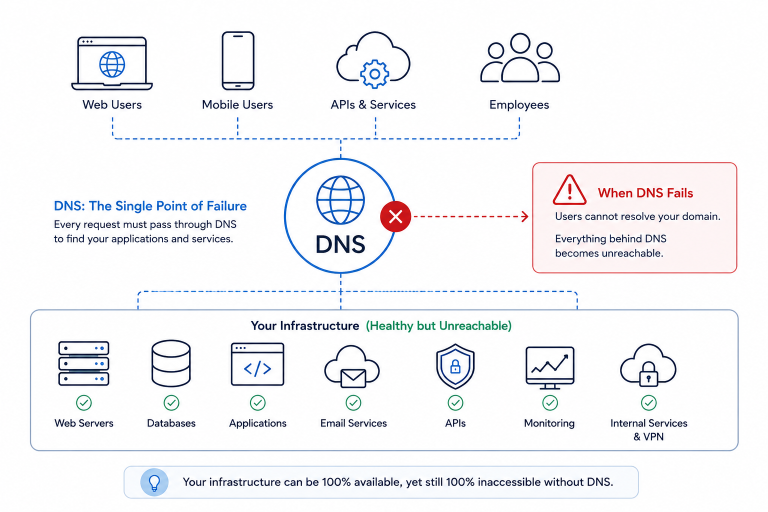
Why DNS is the most underestimated single point of failure in your infrastructure If you are responsible for infrastructure at a midsize enterprise, you have probably spent a considerable amount of time and money removing single points of failure. Workloads may be distributed across multiple data centers or availability zones. Databases are replicated. Network and […]

Nadet Rautenbach

Blogs · Cloud DNS

Your DNS may be in the same failure domain as your CDN or Cloud Provider

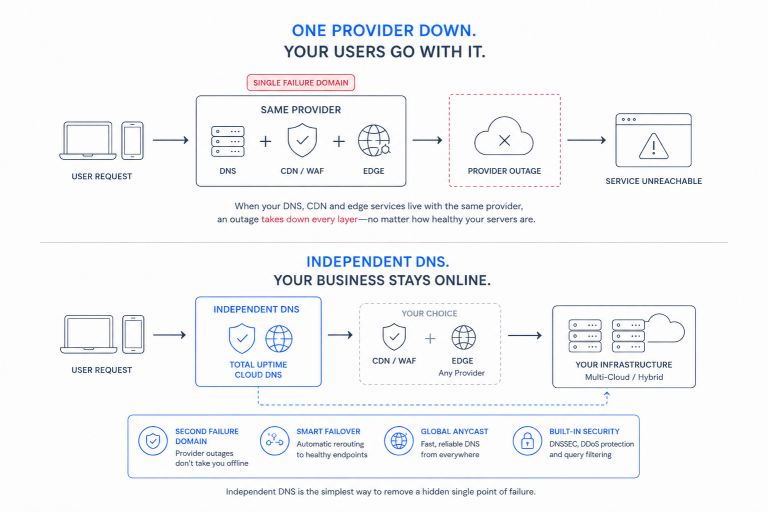
Your DNS may be in the same failure domain as your CDN or Cloud Provider    You have redundant servers. Multiple availability zones. Health checks. A CDN. A WAF. Perhaps even a second cloud region ready to take traffic.  But there is a question that is surprisingly easy to overlook:    Who runs your DNS?    If the answer is […]

Nadet Rautenbach