Looking for an Alternative to F5?

F5 has set the benchmark for enterprise application delivery. But not every organization needs the complexity that has accumulated around a large application delivery and security stack.  Total Uptime brings application delivery, availability, security and connectivity together across cloud, on-premises and hybrid environments, with managed and self-hosted deployment options.

Total Uptime vs F5 Comparison

F5 is the benchmark. It doesn't have to be the blueprint.

The F5 way

F5 demonstrates why modern organizations increasingly need application delivery, security, networking and visibility to work together rather than as isolated technologies. Its portfolio spans BIG-IP, Distributed Cloud and NGINX across traditional and modern application environments  But following the same platform logic does not mean following the same architecture.

The Total Uptime way

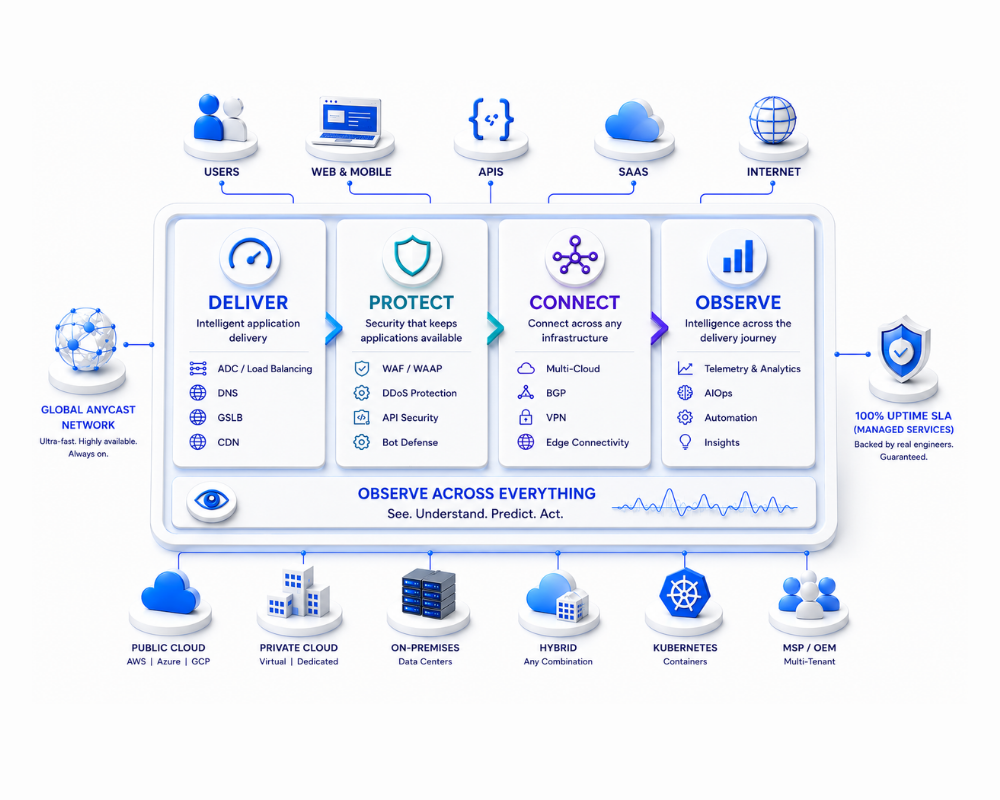
Total Uptime takes a different approach: bring the application delivery capabilities organizations need together while reducing unnecessary operational complexity.

The goal isn’t to build another F5.  It’s to make enterprise application delivery simpler.

Different approaches to application delivery

Total Uptime vs F5

When F5 capability is more than you need

The question is whether its operating model is the right fit for your applications, infrastructure and team.

Simplify application delivery

Reduce the number of disconnected application delivery, DNS, traffic management and security services your team needs to operate.

Modernize aging ADC infrastructure

An F5 hardware refresh can be an opportunity to reconsider the architecture rather than simply replacing one appliance generation with another.

Support hybrid infrastructure

Deliver applications consistently across data centers, private infrastructure and public cloud environments.

Reduce cloud dependency

Build resilience across AWS, Azure, Google Cloud and on-premises infrastructure without making a single cloud provider your application delivery strategy.

Choose managed or self-hosted

Use managed application delivery where it makes sense and retain infrastructure control where it matters.

Get closer to the engineers

Work with an application delivery team rather than navigating an unnecessarily large vendor ecosystem.

One application delivery strategy. Across every environment.

TU Application Delivery Unified

You may not need to replace everything to start changing the architecture.

F5 ADC refresh

Replace aging application delivery infrastructure with modern physical, virtual, cloud or managed deployment options.

DNS & GSLB

Introduce an independent global traffic-management and DNS layer to improve application availability and reduce failure-domain dependency.

Disaster recovery

Use health-based traffic management and GSLB to redirect users toward healthy infrastructure when applications or environments fail.

Hybrid application delivery

Operate across cloud and on-premises infrastructure without forcing every application into the same deployment model.

Multi-cloud application delivery

Distribute applications across providers while maintaining an independent traffic and connectivity layer.

Managed application delivery

Move operational responsibility for selected application delivery functions to Total Uptime rather than managing every component internally.

Your infrastructure. Your way.

Total Uptime lets organizations choose how application delivery is deployed based on the workload rather than forcing every application into the same model.

Virtual

Deploy across VMware, Hyper-V, KVM and Nutanix environments.

Physical

EdgeADC appliances for infrastructure requiring dedicated deployment.

Public Cloud

Support application delivery across AWS, Azure and Google Cloud.

Managed Services

Consume ADC, load balancing, DNS, GSLB and security capabilities as managed services.

Hybrid

Combine self-hosted and managed services across cloud and on-premises infrastructure.

MSP / OEM

Support multi-tenant and service-provider application delivery models.

F5 and Total Uptime can coexist.

Not ready to leave F5 completely? You don’t need a disruptive “big bang” migration to start simplifying your F5 estate. Start where the business case is strongest. Expand when it makes sense.

DNS and GSLB

Disaster recovery

New cloud workloads

WAF / WAAP

A practical path from F5 to Total Uptime

Assess

Understand your current F5 estate, applications, dependencies and availability requirements.

Discover

Map virtual servers, pools, nodes, health monitors, SSL, persistence, traffic policies and DNS/GTM requirements.

Classify

Identify what can be migrated directly, what needs redesign and what should remain in place.

Pilot

Select a suitable application or service and prove availability, performance and operational simplicity.

Migrate

Move applications in controlled phases with defined success and rollback criteria.

Expand

Extend Total Uptime into additional application delivery, DNS, security, resilience and networking requirements.

Is Total Uptime or F5 right for you?

F5 may be the better fit if...

– You require the breadth and depth of the complete F5 ecosystem.


– You rely heavily on advanced F5-specific functionality.


– Your architecture is deeply built around BIG-IP, Distributed Cloud or NGINX technologies.


– You require advanced capabilities that are not currently part of the Total Uptime portfolio.

Total Uptime may be the better fit if...

– You want strong ADC, load balancing, DNS and GSLB capabilities without unnecessary platform complexity.


– You operate applications across cloud and on-premises infrastructure.


– You want a choice between managed and self-hosted application delivery.


– You want to reduce dependence on individual infrastructure or cloud providers.


– You value transparent architecture and direct access to application delivery expertise.


– You want to modernize your application delivery architecture incrementally rather than undertake a wholesale replacement.

Frequently asked questions

Quick answers to the questions infrastructure teams ask most.

What is the best alternative to F5 BIG-IP?

The best F5 BIG-IP alternative depends on the capabilities your applications actually require. Organizations primarily using F5 for ADC, load balancing, DNS, GSLB, WAF and hybrid application delivery may consider Total Uptime when they want to simplify their architecture or combine managed and self-hosted application delivery.

Total Uptime can replace or complement F5 infrastructure for many ADC, load balancing, DNS, GSLB and application delivery use cases. More complex F5 estates should be assessed application by application to determine which services can be migrated, redesigned or retained.

Yes. Total Uptime can be introduced alongside existing F5 infrastructure for services such as DNS, GSLB, disaster recovery, cloud application delivery, security and multi-cloud connectivity.

F5 provides a broad enterprise application delivery and security portfolio across BIG-IP, Distributed Cloud and NGINX. Total Uptime focuses on simplifying application delivery and resilience across cloud, on-premises and hybrid environments with both managed and self-hosted options.

Yes. Total Uptime supports physical and virtual application delivery infrastructure alongside cloud and managed services, enabling hybrid architectures.

Yes. A phased migration can begin with selected applications, DNS/GSLB, disaster recovery or new cloud workloads before expanding into additional application delivery services.

Customer success

Trusted by IT Teams Worldwide

Real organisations. Real resilience. Real results.

Rated by the people who use us.

Considering your next move from F5?

You don’t need to decide whether to replace your entire F5 estate before talking to us.  Start by understanding which parts of your application delivery architecture are still serving you and which are creating unnecessary cost, complexity or dependency.