Looking for a simpler alternative to Kemp?

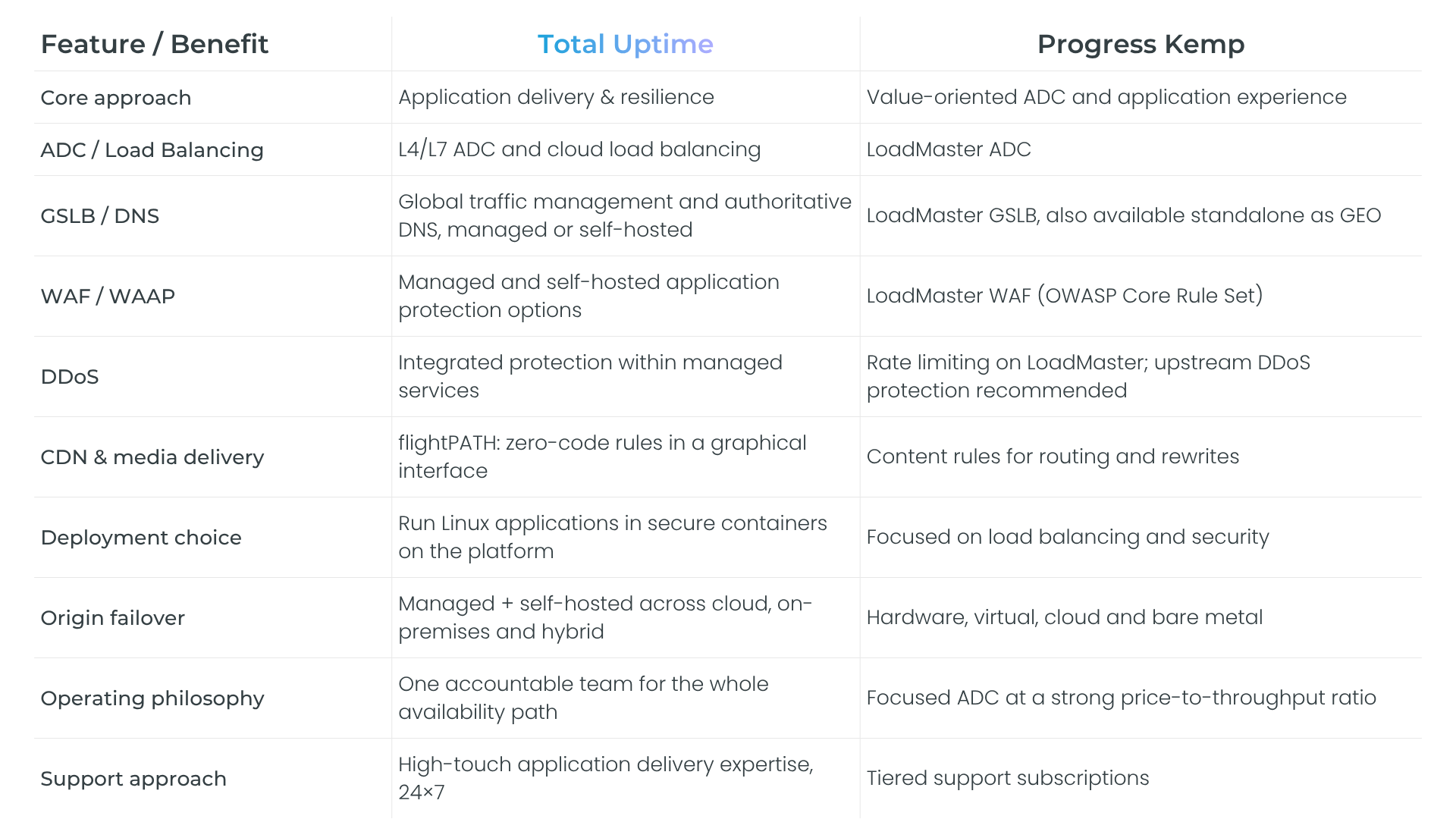
Progress Kemp LoadMaster is a capable, value-oriented ADC. If you’re only refreshing an ADC, compare the appliances. If the whole service must stay available across sites and clouds, compare the complete operating model. Total Uptime is a Kemp LoadMaster alternative that brings load balancing, WAF, DNS and GSLB together, with managed and self-hosted deployment options.

Total-Uptime-vs-Progress-Kemp-Comparison

LoadMaster is a capable ADC. Availability needs more than one box.

The Kemp way

LoadMaster is a value-oriented ADC across hardware, virtual and cloud deployments, with WAF, GSLB and centralized management through LoadMaster 360. It is far more than a basic load balancer, and many teams know it well.

The Total Uptime way

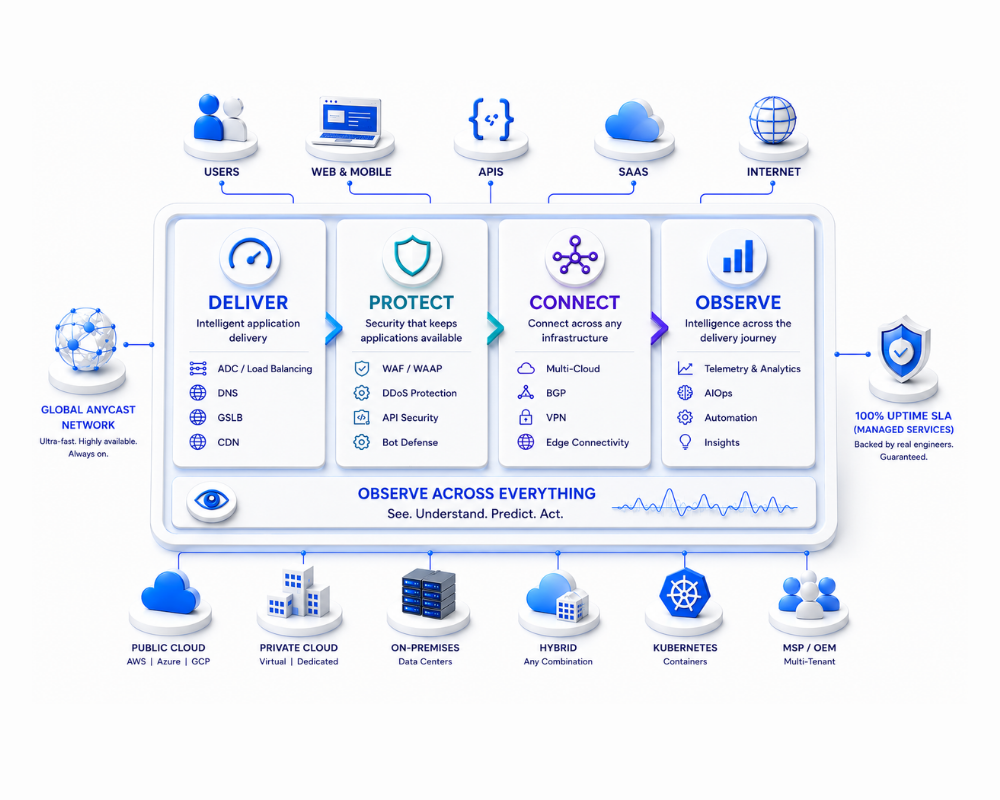
Total Uptime gives you one accountable portfolio for when a local ADC purchase grows into DNS, multi-site failover, cloud protection and managed delivery. It adds zero-code traffic rules with flightPATH and applications running inside the platform.

The goal isn’t a cheaper box. It’s keeping the whole service available, wherever it runs.

Kemp LoadMaster alternative or extension? Two different approaches

Total-Uptime-vs-Kemp-Comparison

When an ADC refresh becomes an availability project

The question is whether a self-managed ADC estate still covers everything your applications need to stay available.

Extend beyond the ADC

Add managed DNS, GSLB, DDoS protection and cloud failover without assembling separate services from separate vendors.

Build traffic rules visually

Create advanced HTTP/HTTPS rules with flightPATH, using built-in conditions, evaluations and actions instead of scripting.

Run applications inside the platform

Run Linux applications in secure containers alongside your load balancer, with no additional hardware.

Hand over day-to-day operations

Use managed services for 24×7 operational ownership where it adds value, or keep the whole deployment self-hosted.

Support hybrid and multi-cloud

Deliver applications consistently across data centers, private infrastructure, AWS, Azure and Google Cloud.

ork with one accountable team

Get DNS, GSLB, ADC and WAF from one vendor, supported by application delivery engineers 24×7.

One application delivery strategy. Across every environment.

TU Application Delivery Unified

You may not need to replace LoadMaster to start.

ADC refresh

Replace aging appliances or virtual instances with modern physical, virtual, cloud or managed deployment options.

Managed DNS & GSLB

Add managed DNS and global traffic management above your existing LoadMaster infrastructure.

Disaster recovery

Use health-based traffic management to redirect users to healthy sites when an application or environment fails.

WAF / WAAP

Introduce managed or self-hosted application protection for selected internet-facing applications.

Hybrid and multi-cloud

Operate across cloud and on-premises infrastructure without forcing every application into the same deployment model.

Managed application delivery

Move operational responsibility for selected application delivery functions to Total Uptime rather than managing every component internally.

Your infrastructure. Your way.

Total Uptime lets organizations choose how application delivery is deployed based on the workload rather than forcing every application into the same model.

Virtual

Deploy across VMware, Hyper-V, KVM and Nutanix environments.

Physical

EdgeADC appliances for infrastructure requiring dedicated deployment.

Public Cloud

Support application delivery across AWS, Azure and Google Cloud.

Managed Services

Consume ADC, load balancing, DNS, GSLB and security capabilities as managed services.

Hybrid

Combine self-hosted and managed services across cloud and on-premises infrastructure.

MSP / OEM

Support multi-tenant and service-provider application delivery models.

Kemp and Total Uptime can coexist.

Your team already knows LoadMaster, and that lowers the cost of change. Keep it in place, add Total Uptime managed DNS and GSLB above it, and modernize the ADC layer when the timing is right.

DNS and GSLB

Disaster recovery

New cloud workloads

WAF / WAAP

A practical path from Kemp to Total Uptime

Assess

Understand your LoadMaster estate, applications, dependencies and availability requirements.

Discover

Map virtual services, real servers, health checks, SSL, persistence, content rules, WAF and GSLB settings.

Compare

Build a feature and throughput matrix for a named application, with costs normalized to the same scope.

Test

Run a live failover drill across DNS, site and ADC before moving production traffic.

Migrate

Move applications in controlled phases with defined success and rollback criteria.

Expand

Extend Total Uptime into additional DNS, GSLB, security, resilience and networking requirements.

Is Total Uptime or Kemp right for you?

Progress Kemp may be the better fit if...

– Your requirement is a straightforward ADC-only refresh.

– Your team has deep LoadMaster expertise and established workflows.

– Global managed DNS, GSLB and DDoS services are out of scope.

Total Uptime may be the better fit if...

– Your ADC purchase is growing into DNS, multi-site failover and cloud protection.

– You want advanced traffic rules without scripting, via flightPATH.

– You want to run applications inside your application delivery platform.

– You want a choice of managed, self-hosted or hybrid delivery.

– Your applications span cloud and on-premises infrastructure.

– You want one accountable team, 24×7.

Frequently asked questions

Quick answers to the questions infrastructure teams ask most.

What is the best Kemp LoadMaster alternative?

It depends on your scope. For a straightforward ADC refresh, compare appliances, throughput and price directly. When your requirements extend into managed DNS, GSLB, DDoS protection and multi-site failover, Total Uptime is a Kemp LoadMaster alternative that brings those services together with managed and self-hosted options.

LoadMaster does include WAF and GSLB, and Total Uptime doesn’t position those as unique. The meaningful differences are deployment architecture, global managed services, support ownership and how failover actually behaves.

For a narrowly scoped ADC, it may be. Compare like-for-like capacity, support, WAF, DNS/GSLB, DDoS and operating effort, with both quotes normalized to the same scope.

Yes. Many organizations keep LoadMaster in place and add Total Uptime managed DNS and GSLB above it, then modernize the ADC layer when the timing is right.

No. Managed services make sense if you value 24×7 operational ownership or global infrastructure. A fully self-hosted deployment remains an option.

Yes. A phased migration can start with DNS/GSLB, disaster recovery, WAF or new cloud workloads before moving the ADC layer.

Customer success

Trusted by IT Teams Worldwide

Real organisations. Real resilience. Real results.

Rated by the people who use us.

Considering your next move from Kemp?

If this is only an ADC refresh, compare the appliances. If you need the whole service available across sites and clouds, compare the complete operating model. Show us what you run today and we’ll help you see where Total Uptime can simplify delivery and improve resilience, without forcing you to start again.