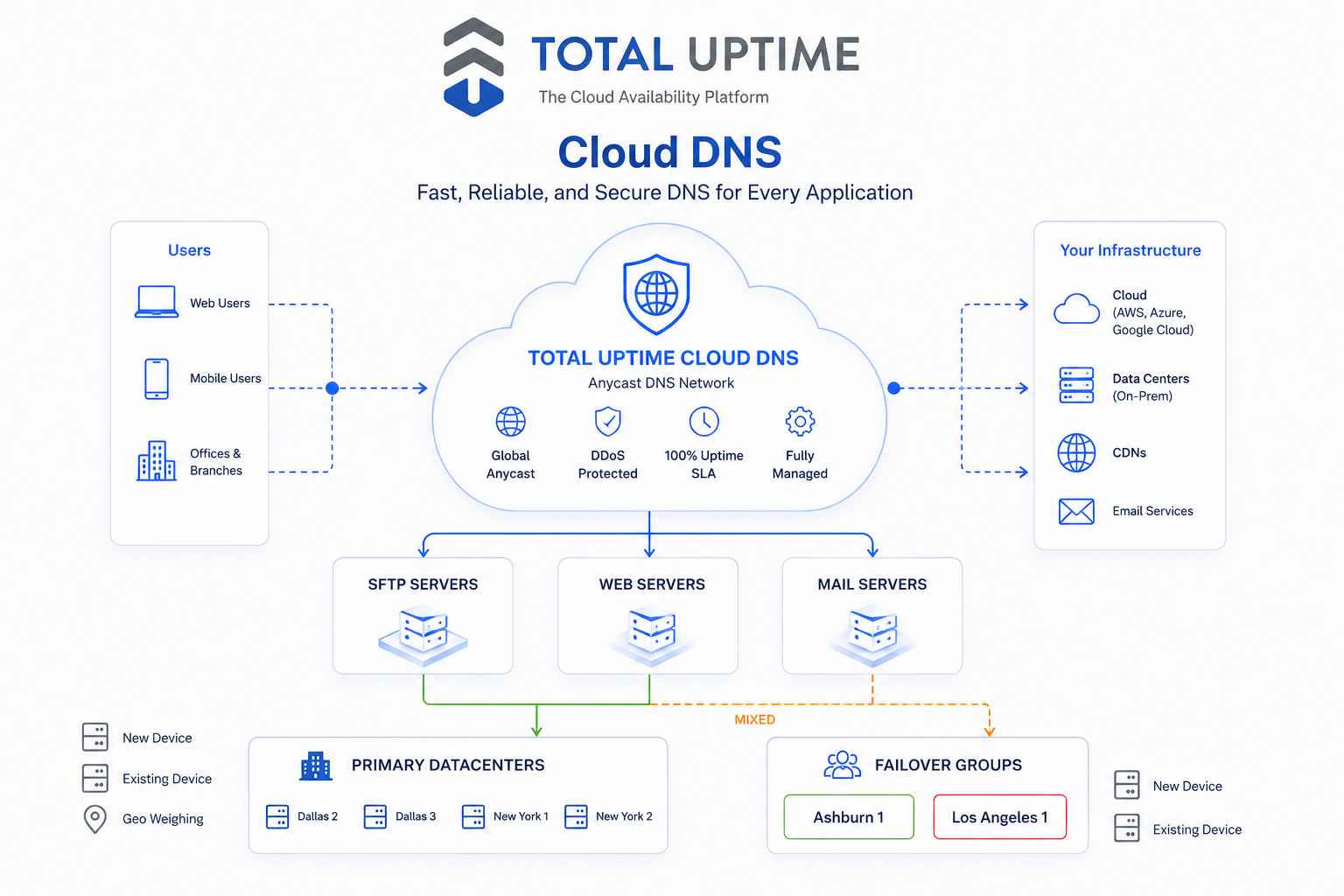
Your applications can be healthy and your network can be online but if DNS fails or keeps sending users to an unavailable endpoint, none of that matters.
Total Uptime Cloud DNS combines authoritative DNS, health monitoring, automated failover and intelligent traffic routing on a globally distributed platform built for critical infrastructure.
Uptime
SLA
Phone
& email support
Most DNS providers deliver only record hosting. To get failover, monitoring, and traffic control, you must combine 3–4 separate tools.
Every component works together. Monitoring triggers failover. Failover updates DNS. DNS routes traffic.
Host and manage business-critical DNS on a globally distributed Anycast platform with DNSSEC, IPv4 and IPv6, flexible TTLs, reverse DNS and comprehensive record support.
Operational result: Reliable name resolution without relying on DNS bundled with a registrar or cloud provider.
Monitor the services behind your DNS records rather than assuming an IP address is healthy because it still responds.
Operational result: Make routing decisions based on application availability, not guesswork.
Connect health checks directly to DNS failover pools so failed endpoints can be removed from DNS responses automatically.
Operational result: Reduce the manual intervention required during an infrastructure incident.
Distribute traffic across endpoints, regions and infrastructure using failover, round-robin and geographic routing policies.
Operational result: Maintain control over where users are sent without tying application availability to one infrastructure provider.
Total Uptime is three products in one: authoritative DNS, DNS traffic management, and integrated monitoring & failover.
High-availability DNS record hosting across a global anycast network. Supports all record types (A, AAAA, CNAME, MX, TXT, NS, PTR), DNSSEC with large DKIM key support, reverse DNS, custom TTL from 60 seconds to 1 year, and any TLD including future TLDs.
Intelligent DNS routing that controls how users reach your infrastructure. Includes DNS failover pools, round-robin and weighted routing, Geo DNS with zone-based and proximity routing, traffic steering, and multi-region/multi-cloud failover capabilities.
Built-in health monitoring (Ping, HTTP, HTTPS, DNS, content-match, custom application checks) that drives automated failover decisions. Includes auto-rejoin control, manual failover override, maintenance windows, and comprehensive alerting.
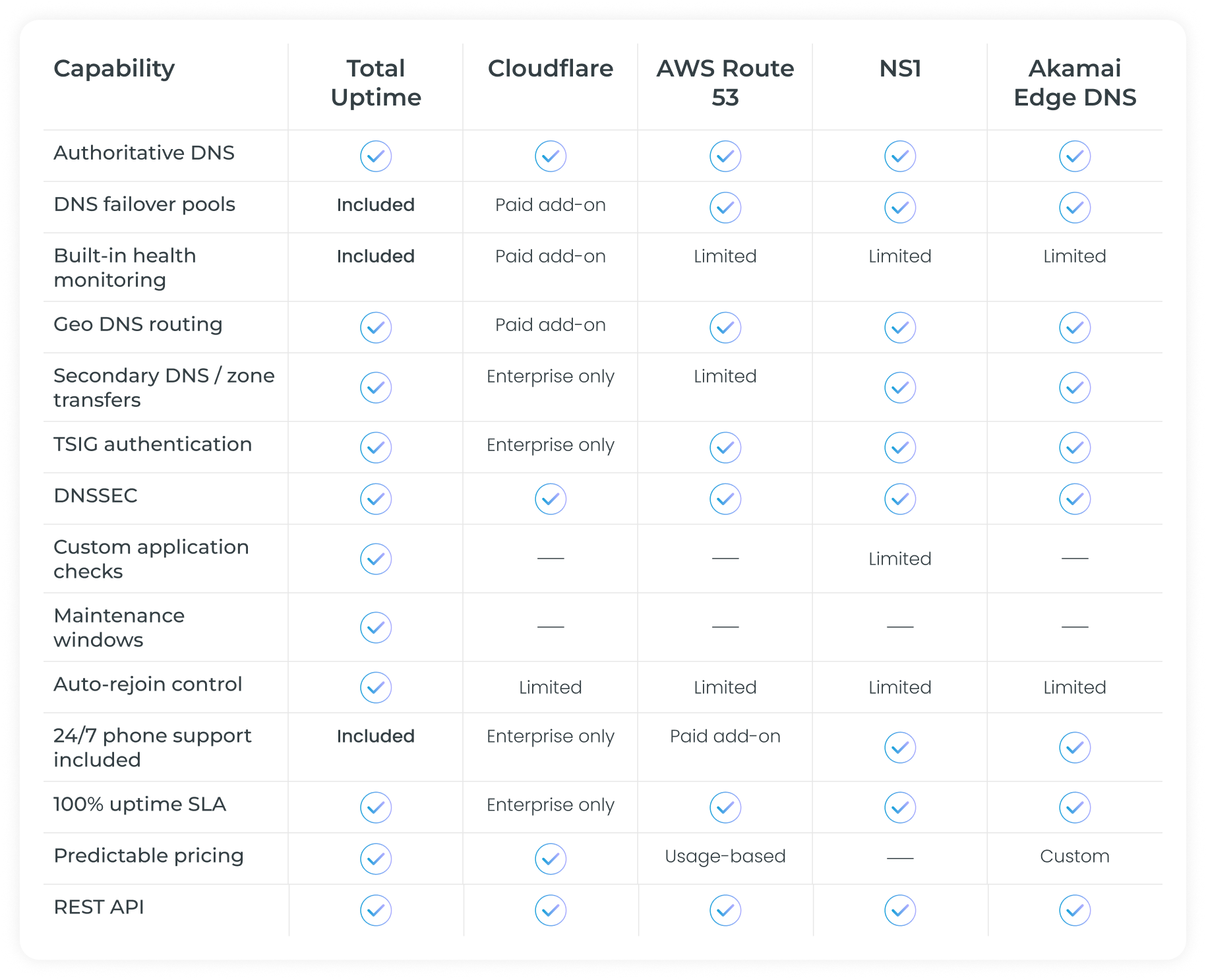
Unlike competitors who separate DNS from monitoring, Total Uptime integrates them. When a server fails, DNS updates automatically.
Group your servers into failover pools with primary and secondary targets. Assign health monitors to each server.
Total Uptime continuously monitors your servers using Ping, HTTP, HTTPS, DNS, or custom application checks from multiple global locations.
When a monitor detects a failure, the system validates the outage from multiple vantage points to prevent false positives.
DNS records are automatically updated to remove the failed server and route traffic to healthy infrastructure. No manual intervention required.
When the server recovers, auto-rejoin controls prevent premature re-addition. Administrators maintain full control over recovery.
Most providers force you to bolt on monitoring, failover, and traffic management as paid add-ons or enterprise tiers. With Total Uptime everything is included.
Consolidate DNS, reduce incident risk, and create sticky recurring revenue with a premium managed DNS product.
Most MSPs manage dozens or hundreds of domains across scattered registrar DNS, Cloudflare, Route 53, and legacy providers. Total Uptime provides one operational model, one interface, one escalation path.
DNS is high-retention, low-touch, and expands naturally as you onboard clients. Package Total Uptime as “Managed DNS + Failover” or “Business Continuity DNS” for easy upselling.
A DNS outage is catastrophic and reputational for MSPs. Total Uptime’s built-in monitoring and failover means infrastructure stays up even when servers fail.
Get partner margin on every DNS subscription. Standardize delivery, offer premium outcomes without engineering overhead. Easy for MSP sales teams to sell.
Full REST API for domain creation, DNS records, failover pools, monitoring, and geo-zones. Integrate into your existing MSP tooling and automation workflows.
Alert lists, maintenance windows, change logs, device status monitoring, RBAC, and 2FA. Everything MSPs need to manage DNS at scale across their client base.
No add-ons. No enterprise tier. No surprise bills. Every Cloud DNS subscription includes failover pools, monitoring, Geo DNS, secondary DNS, 24/7 email support, and a 100% uptime SLA.
Articles from our knowledge base on DNS failover, Geo DNS, DNSSEC, and zone transfers.
Instant Disaster Recovery: Move Your Applications Without Changing a Single IP Disaster recovery has quietly become a compliance problem as much as a technical one. Under the EU’s Digital Operational
The static IP that doesn’t break when your ISP does Ask any IT manager what happens when their primary internet provider goes down, and you’ll usually hear the same reassuring
Today’s networks are focused on results. It’s not enough to have active connections with no errors. Customers expect that IT management teams do their best to deliver the applications that
What is it? And how can you implement it? SHORTCUT: If you just want to get to the part about configuring GSLB in the Total Uptime panel, skip to it
If you are goal-oriented, you know how important it is to measure success. For network professionals, the goal is usually 99.999% availability (well, 100% in our world). But despite all
DNS Security starts with knowledge We recently released a new feature that will help DNS admins stay in the know. It helps by actively monitoring your DNS zone within the
Quick answers to the questions infrastructure teams ask most.
Authoritative DNS only hosts records and responds to queries — there is no monitoring, no failover, and no traffic intelligence. When a server goes down, DNS keeps pointing at the dead server until somebody manually updates the record. Comprehensive DNS (Total Uptime) hosts the records and continuously monitors your servers. When a failure is detected, DNS is automatically updated to route traffic to healthy infrastructure.
DNS failover uses health monitors to detect when servers become unavailable. When a monitor detects a failure — via Ping, HTTP, HTTPS, or a custom application check — the DNS system automatically removes the failed server from responses and directs traffic to healthy servers in the failover pool. Total Uptime’s pools support configurable thresholds, auto-rejoin controls to prevent premature recovery, manual overrides, and maintenance windows to suppress alerts during planned work.
Yes. Total Uptime supports full AXFR and IXFR zone transfers with TSIG authentication, so you can run us as your primary or as a secondary alongside an existing provider for true multi-provider redundancy. No vendor lock-in.
Yes. 24/7/365 phone and email support is included in every Cloud DNS subscription — not gated behind an enterprise tier or paid add-on.
Total Uptime backs the platform with a 100% uptime SLA on DNS query response. The service has run for six consecutive years without a global outage. Full SLA terms are available in the master services agreement.
Real organisations. Real resilience. Real results.
Our team found that implementation went very smoothly, and Total Uptime support staff was always ready and willing to help within minutes.
Director, Product Operations, Informatica
We chose Total Uptime for its advanced functionality, cost effective pricing and superb pre-sales experience. The intuitive configuration and ‘dead-easy’ deployment were also significant factors in our purchasing decision.
Senior Systems Analyst, MIC
Yes, the load balancer rocks. But for us, the stand-out feature is the team behind it. Edgenexus support is fast, responsive, and deeply knowledgeable, a true extension of our IT department.
IT System and Asset Manager, 4D Interactive Ltd
Having technically reviewed the solutions available in the market place, we felt that Total Uptime hit all the functionality of the big players, at a very reasonable price point for the feature set available.
IT Operations Manager,
UNITE Group
Your application shouldn’t depend on a manual DNS change during an outage. Design DNS as part of your availability architecture before the next failure tests it for you.