Akamai is one of the world’s leading edge platforms. Total Uptime answers a different question: can your applications stay reachable when a site, cloud or origin fails? Total Uptime brings DNS, GSLB, application delivery and WAF together across cloud, on-premises and hybrid environments, with managed and self-hosted deployment options. Whether you need an Akamai alternative or a partner to it, the answer often involves both.
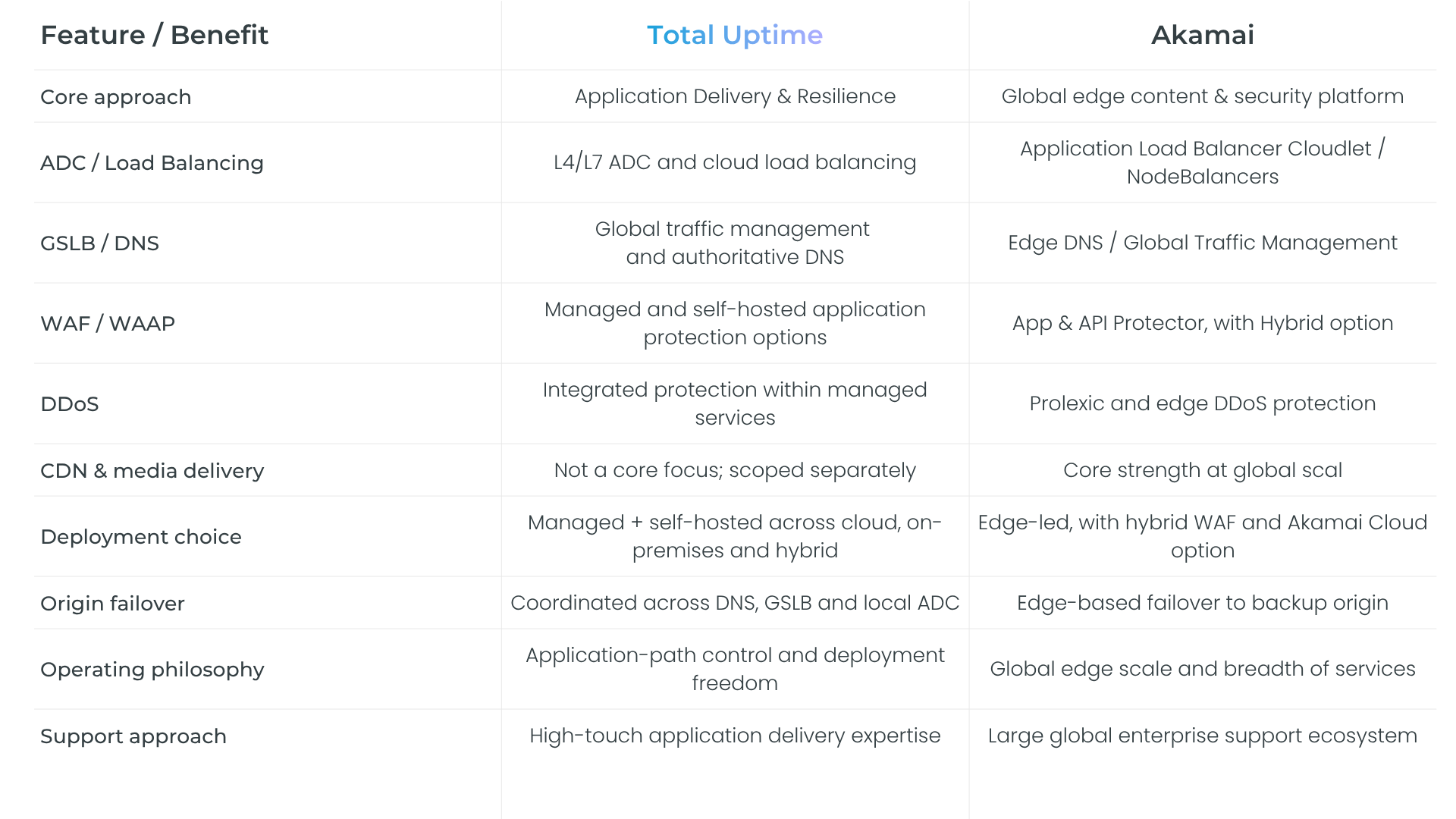
Akamai is an edge heavyweight in CDN, media delivery, DDoS mitigation and application and API security, with cloud computing and hybrid application protection options alongside. Its strength is scale: a globally distributed platform built to accelerate and protect traffic close to users.
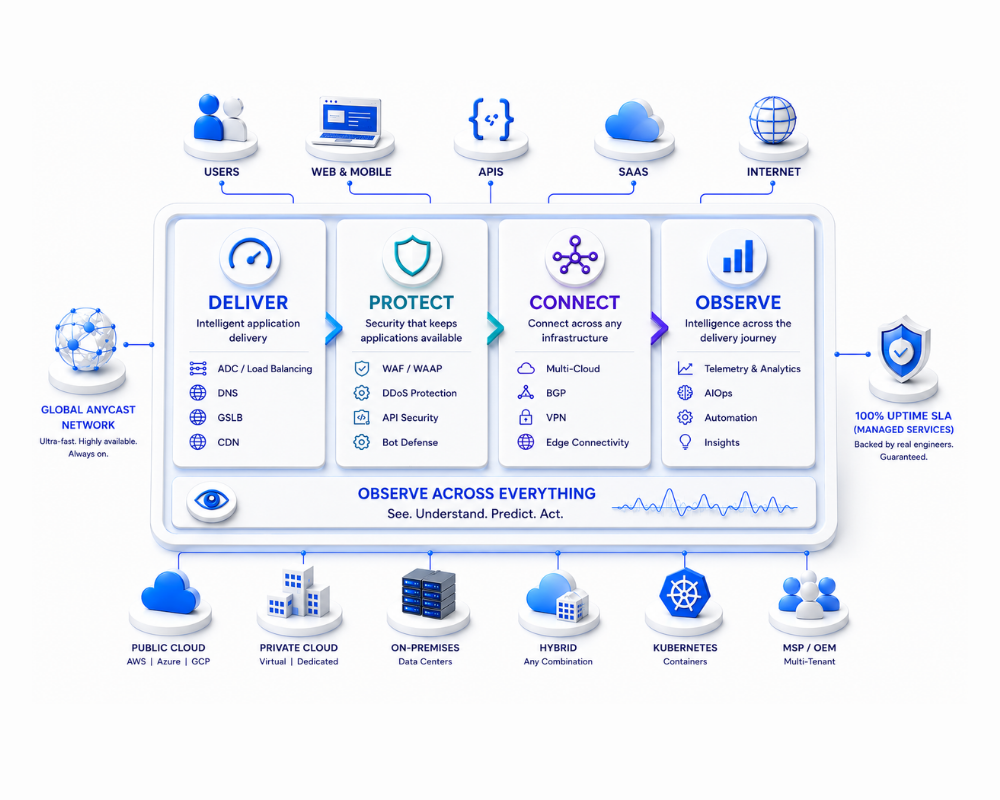
Total Uptime focuses on the application path. DNS, global server load balancing, local ADC and WAF work together around failover and origin resilience, across the data centers and clouds you control.
Akamai protects and accelerates traffic on the way in. The question is what happens when the site, cloud or origin behind it fails.
Coordinate DNS, GSLB and origin failover so users reach healthy infrastructure when a site, cloud or origin goes down.
Deliver applications that must stay inside private data centers or regulated environments, with local ADC and WAF you control.
Run DNS and failover independently of your edge provider, so no single platform becomes a single point of failure.
Replace aging on-premises load balancers with a modern ADC that works alongside your edge platform.
Use managed application delivery where it makes sense and retain infrastructure control where it matters.
Work directly with application delivery engineers who test failover against your real topology.
Add an independent DNS provider so name resolution continues if a single DNS platform is disrupted.
Route users by location and health, and fail over automatically between regions, sites and clouds.
Test and automate failover between data centers and clouds, independently of the edge in front of them.
Replace aging on-premises load balancers with modern physical, virtual, cloud or managed deployment options.
Protect applications that must stay inside controlled infrastructure with self-hosted ADC and WAF.
Move operational responsibility for selected application delivery functions to Total Uptime rather than managing every component internally.
Total Uptime lets organizations choose how application delivery is deployed based on the workload rather than forcing every application into the same model.
Deploy across VMware, Hyper-V, KVM and Nutanix environments.
EdgeADC appliances for infrastructure requiring dedicated deployment.
Support application delivery across AWS, Azure and Google Cloud.
Consume ADC, load balancing, DNS, GSLB and security capabilities as managed services.
Combine self-hosted and managed services across cloud and on-premises infrastructure.
Support multi-tenant and service-provider application delivery models.
Already on Akamai? Keep it. Replacement isn’t the default. Many organizations add Total Uptime to strengthen the path behind the edge, then expand when the case is proven.
Understand your applications, sites, clouds and availability requirements.
Separate media, static content and dynamic application traffic, so each is judged on its own terms.
Document where DNS, GSLB, ADC and WAF run today, who operates them and how incidents escalate.
Prove DNS/GSLB and origin failover against your real topology.
Introduce Total Uptime in controlled phases with defined success and rollback criteria.
Extend into additional DNS, application delivery, security and networking requirements.
– Global CDN scale and media delivery are your deciding requirements.
– You need Akamai’s breadth of edge compute and edge security services.
– Most of your traffic is content acceleration rather than application routing.
– Your applications span private data centers and multiple clouds.
– You need DNS, GSLB, ADC and WAF coordinated around failover.
– Some workloads must stay inside controlled or regulated infrastructure.
– You want an independent resilience path alongside your edge provider.
– You want a choice between managed and self-hosted application delivery.
– You value direct access to application delivery engineers.
Quick answers to the questions infrastructure teams ask most.
It depends on what you use Akamai for. If CDN scale and media delivery are your deciding requirements, Akamai remains a strong choice. Organizations primarily using Akamai for DNS, global traffic management, load balancing or WAF may consider Total Uptime as an Akamai alternative, particularly across hybrid and multi-cloud environments.
For DNS, GSLB, load balancing, ADC and WAF use cases, Total Uptime can replace or complement Akamai services. Total Uptime does not compete on global CDN or media delivery, so video, streaming and large-download traffic are scoped separately.
Yes. Many organizations keep Akamai at the edge and add Total Uptime for secondary DNS, independent origin failover or local ADC modernization.
Akamai is a global edge platform for content delivery, edge security and cloud computing. Total Uptime is a hybrid application delivery and availability platform, focused on keeping applications reachable across the sites and clouds you control, with managed and self-hosted options.
Akamai’s App & API Protector Hybrid extends its WAF beyond the edge. Compare the policy depth and deployment model you need directly. Total Uptime’s difference is the broader availability workflow: DNS, GSLB and local ADC working alongside managed or self-hosted WAF.
Yes. Total Uptime supports physical and virtual application delivery infrastructure alongside cloud and managed services, including workloads that must remain inside private or regulated environments.
Real organisations. Real resilience. Real results.
Our team found that implementation went very smoothly, and Total Uptime support staff was always ready and willing to help within minutes.
Director, Product Operations, Informatica
We chose Total Uptime for its advanced functionality, cost effective pricing and superb pre-sales experience. The intuitive configuration and ‘dead-easy’ deployment were also significant factors in our purchasing decision.
Senior Systems Analyst, MIC
Yes, the load balancer rocks. But for us, the stand-out feature is the team behind it. Edgenexus support is fast, responsive, and deeply knowledgeable, a true extension of our IT department.
IT System and Asset Manager, 4D Interactive Ltd
Having technically reviewed the solutions available in the market place, we felt that Total Uptime hit all the functionality of the big players, at a very reasonable price point for the feature set available.
IT Operations Manager,
UNITE Group
Akamai is excellent at edge delivery. You don’t need to replace it to start. Show us what you run today and we’ll prove the end-to-end route to your applications, including the sites and clouds you control.