Looking for an alternative to Cloudflare?

Cloudflare has made global edge services easy to adopt. Total Uptime is built for organizations that also need application delivery inside environments they control, with one team accountable for the whole path. As a Cloudflare alternative or a partner to it, Total Uptime brings DNS, GSLB, ADC and WAF together across cloud, on-premises and hybrid environments.

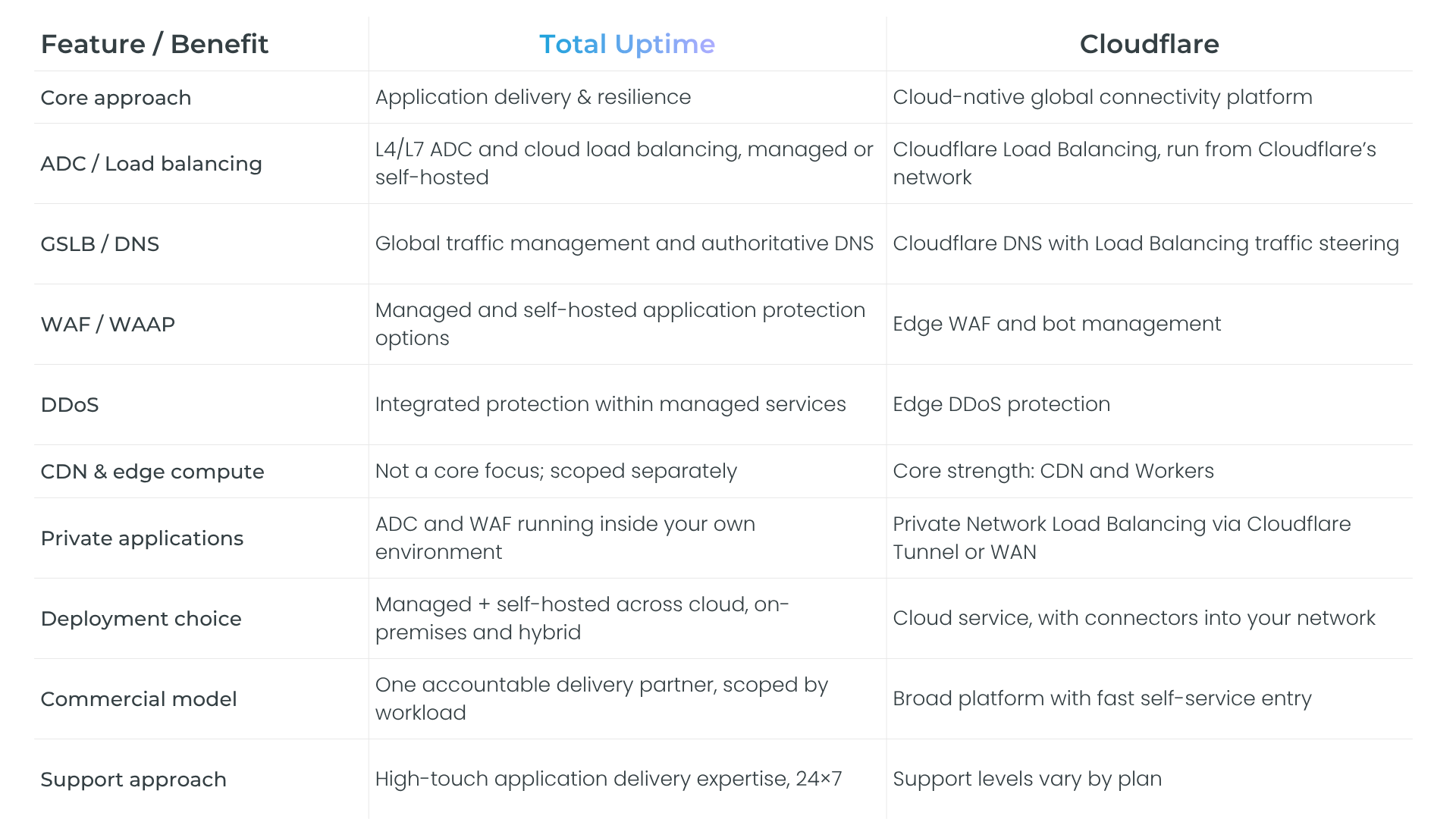
Total-Uptime-vs-Cloudflare-Comparison

Cloudflare runs a global edge.
Some delivery has to run in yours.

The Cloudflare way

Cloudflare combines a very large global edge network with CDN, WAF, bot and DDoS protection, Zero Trust and developer services. Its breadth and fast self-service adoption are genuine strengths.

The Total Uptime way

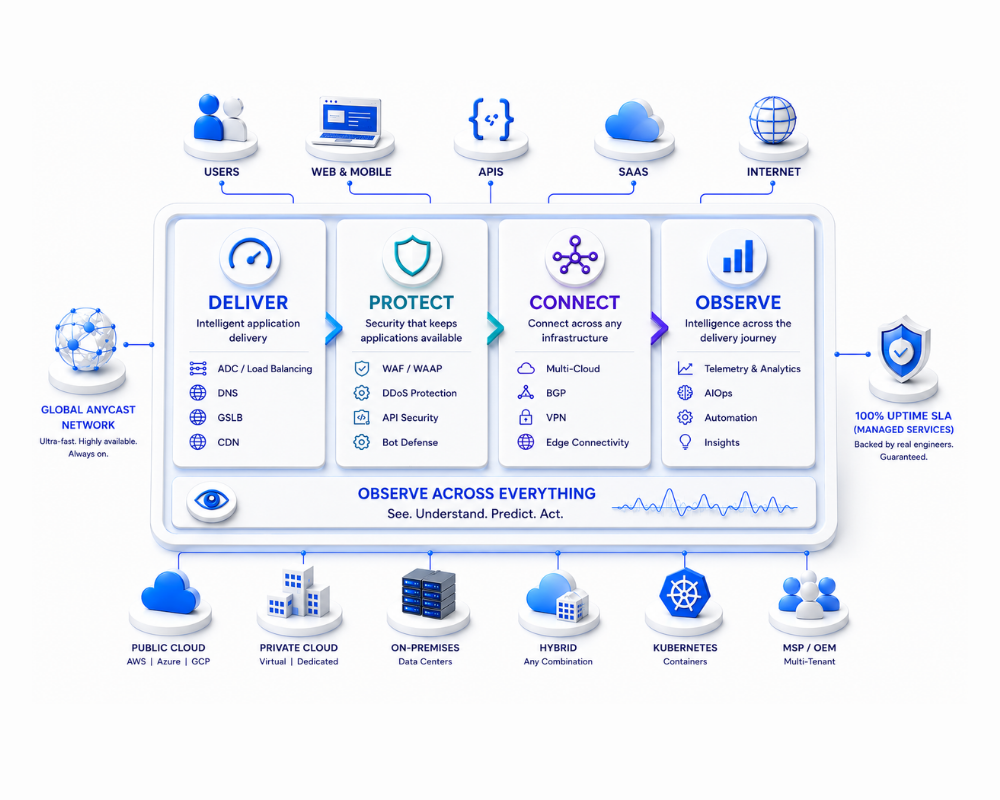
Total Uptime unifies application delivery across managed cloud and self-hosted environments. It is strongest where ADC or WAF must run inside your own environment, alongside managed DNS, GSLB and internet-facing protection.

The goal isn’t more edge reach. It’s reliable routing and recovery across your own application estate.

Cloudflare alternative or addition?
Two different approaches.

When enforcement needs to run where your applications live

Cloudflare is strong at the edge. The question is where traffic is inspected and routed, and who owns the path when something fails.

Keep enforcement in your environment

Run ADC and WAF inside the data centers and private clouds you control, for regulated or private applications.

Prove failover end to end

Measure time to a tested failover across DNS, origin and site, not just time to switch on a proxy.

Reduce single-provider dependency

Add secondary DNS, origin resilience and local ADC controls to create a second delivery path.

Deliver private applications

Serve internal applications without routing every request through a third-party edge network.

Choose managed or self-hosted

Use managed application delivery where it makes sense and retain infrastructure control where it matters.

Get closer to the engineers

Work directly with application delivery engineers and one accountable partner, 24×7.

One application delivery strategy. Across every environment.

TU Application Delivery Unified

You don’t need to leave Cloudflare to build resilience behind it.

Secondary DNS

Add an independent DNS provider so name resolution continues if a single DNS platform is disrupted.

DNS & GSLB

Route users by location and health, and fail over automatically between sites, regions and clouds.

Origin failover

Test and automate failover between data centers and clouds, independently of the edge in front of them.

Self-hosted ADC

Add a local ADC inside your own environment, with physical, virtual or cloud deployment options.

Private and regulated workloads

Protect applications that must stay inside controlled infrastructure with self-hosted ADC and WAF.

Managed application delivery

Move operational responsibility for selected application delivery functions to Total Uptime rather than managing every component internally.

Your infrastructure. Your way.

Total Uptime lets organizations choose how application delivery is deployed based on the workload rather than forcing every application into the same model.

Virtual

Deploy across VMware, Hyper-V, KVM and Nutanix environments.

Physical

EdgeADC appliances for infrastructure requiring dedicated deployment.

Public Cloud

Support application delivery across AWS, Azure and Google Cloud.

Managed Services

Consume ADC, load balancing, DNS, GSLB and security capabilities as managed services.

Hybrid

Combine self-hosted and managed services across cloud and on-premises infrastructure.

MSP / OEM

Support multi-tenant and service-provider application delivery models.

Cloudflare and Total Uptime can work together.

If Cloudflare is working for you, keep what works. Often the right answer is to complement your edge provider, not replace it. Keep Cloudflare at the edge and build resilience behind it.

Secondary DNS

Self-hosted ADC

Origin failover

Private WAF

A practical path to end-to-end availability

Assess

Understand your applications, sites, clouds and which failures matter most: origin, cloud, ISP, DNS or local ADC.

Review the topology

Map DNS, edge, origin, ADC and DR site end to end

Test failover

Run a timed test with real health checks and real failure, measuring recovery and rollback.

Agree boundaries

Put the deployment scope and a named 24×7 escalation path in writing.

Deploy

Introduce Total Uptime in controlled phases with defined success and rollback criteria.

Expand

Extend into additional DNS, application delivery, security and networking requirements.

Is Total Uptime or Cloudflare right for you?

Cloudflare may be the better fit if...

– You need Workers, broad Zero Trust services or advanced bot intelligence.

– Your applications are primarily public, cloud-native and edge-first.

– Self-service adoption and a global edge footprint are your top priorities.

Total Uptime may be the better fit if...

– ADC or WAF enforcement must run in your own environment.

– Critical applications span private infrastructure and multiple clouds.

– You want to reduce dependency on a single edge provider.

– You want a choice of managed, self-hosted or hybrid delivery.

– You want direct access to engineers and one accountable partner.

Frequently asked questions

Quick answers to the questions infrastructure teams ask most.

What is the best alternative to Cloudflare?

It depends on what you use Cloudflare for. For CDN, Workers and broad edge services, Cloudflare remains a strong choice. When ADC or WAF must run inside your own environment, or you need one team accountable for availability across private infrastructure and multiple clouds, Total Uptime is a Cloudflare alternative to consider.

Cloudflare is strong there. The distinction is where enforcement runs and who owns the full path. Total Uptime can run ADC and WAF in your environment alongside managed DNS and GSLB, starting with a map of your traffic path.

For a simple public site, it likely is. Total Uptime is strongest with private applications, multi-site failover and controlled deployment. Measure time to a tested failover, not just time to switch on a proxy.

It depends on what you need. The real question is whether you need global content reach, or reliable routing and recovery across your specific application estate.

Yes. Many organizations keep Cloudflare at the edge and add secondary DNS, a self-hosted ADC or independent origin failover to build resilience behind it.

Yes. Total Uptime supports physical and virtual application delivery infrastructure alongside cloud and managed services, including workloads that must remain inside private or regulated environments.

Customer success

Trusted by IT Teams Worldwide

Real organisations. Real resilience. Real results.

Rated by the people who use us.

Keep what works. Prove the path behind it.

If Cloudflare is working for you, keep it. Let us prove the availability path across your private ADC, DNS, clouds and failover, with one team accountable. Show us what you run today and we’ll help you see where Total Uptime can improve resilience, without forcing you to start again.