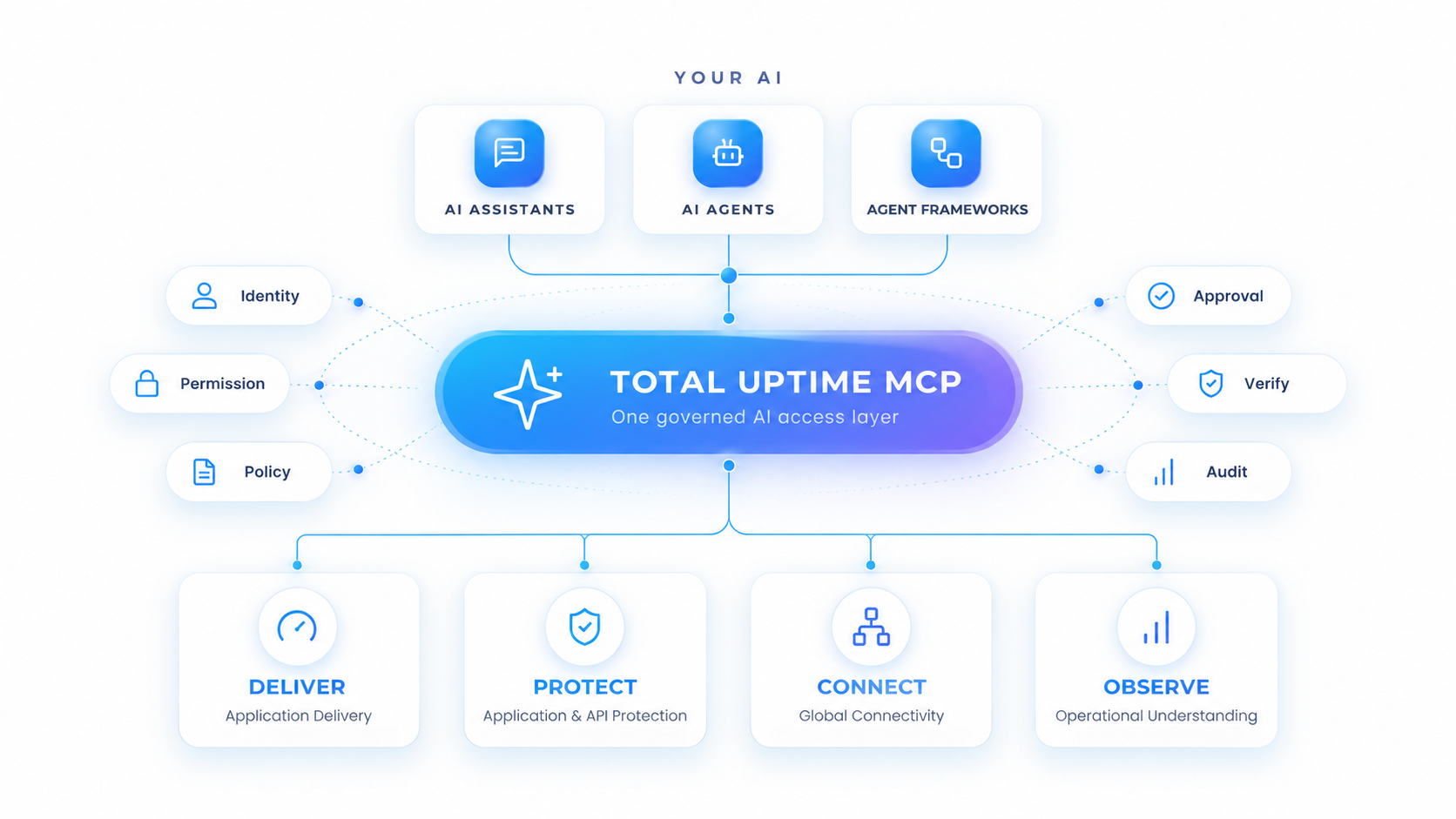
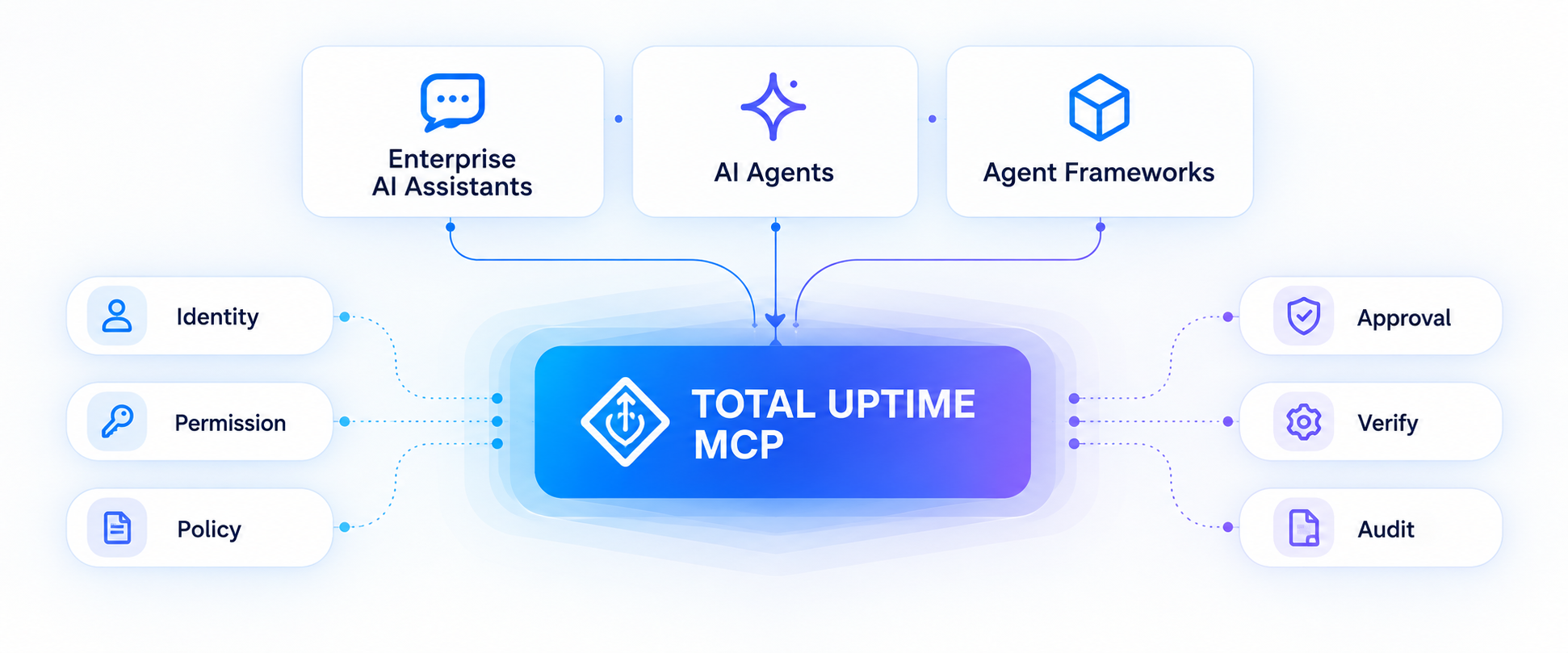
Give your approved AI assistants and agents a governed way to work across Total Uptime application delivery, protection, connectivity and observability. Built on the Model Context Protocol, Total Uptime MCP provides one standard AI access layer with identity, permissions, policy, approvals and audit built in.
Give AI access to operational context across the application path, not one tool at a time.
Use compatible assistants, agents and frameworks through one standard MCP interface.
Control what each identity can see, call and change, with approvals and audit built in.
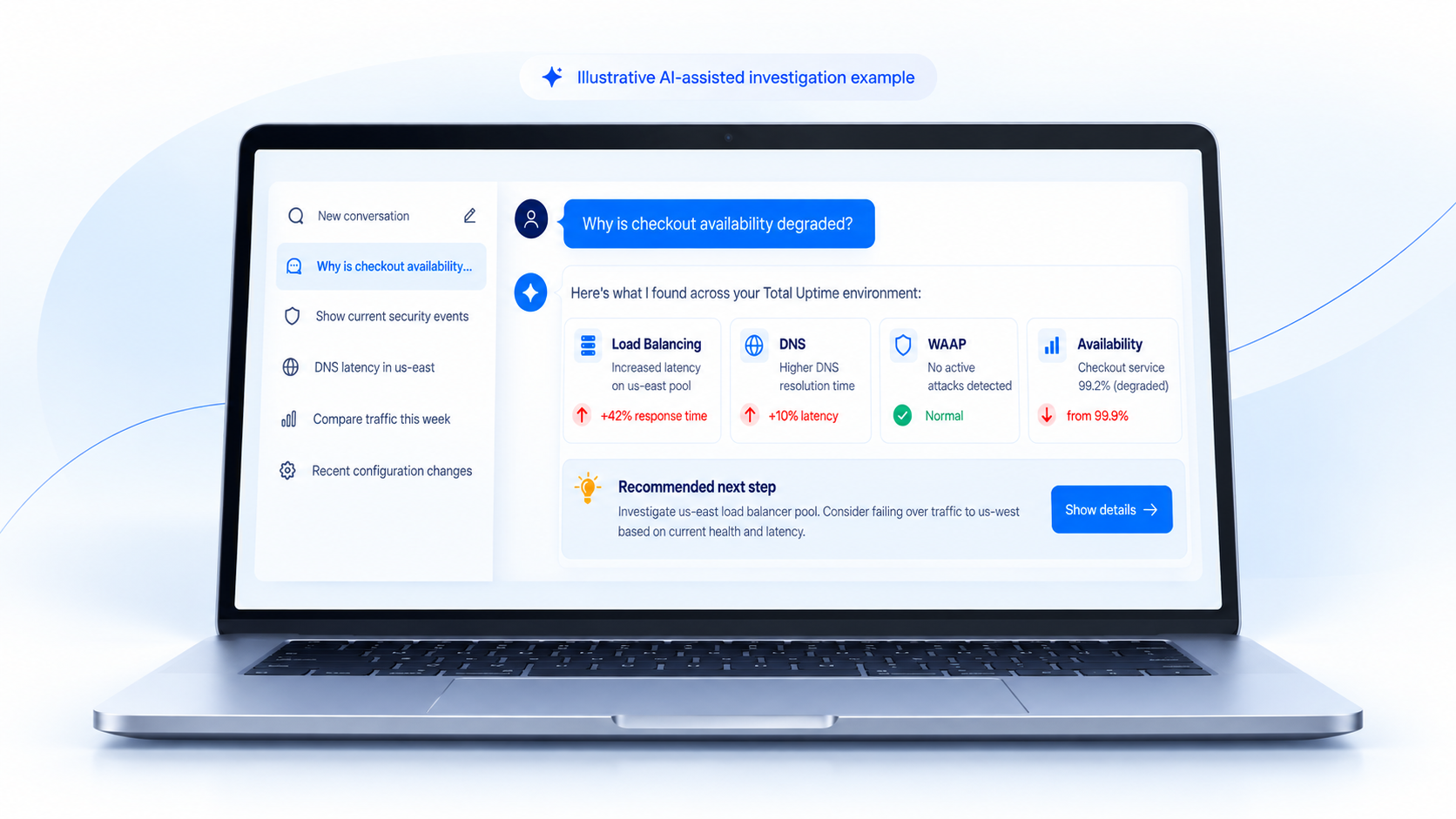
When an application slows down or becomes unavailable, teams often jump between delivery, DNS, connectivity, protection and health data. Total Uptime MCP brings approved context together so AI can help investigate, correlate and recommend the next step.
read-only by default
Total Uptime MCP connects AI to the services that keep your applications running.
Application delivery context from ADC, load balancing, GSLB and failover.
Application and API protection context from WAF, WAAP and security controls.
DNS, Anycast, BGP and hybrid or multi-cloud connectivity context.
Health, events, metrics, availability and operational insights.
Read-only insight. Ask questions and investigate without changing the environment.
AI recommends. Get next-step recommendations while operators retain approval and execution.
Approved actions. Run pre-approved workflows inside defined policy and audit boundaries.
MCP does not give AI unrestricted access to your infrastructure. Your choice of AI client, identity approach, permissions and operating model remain under your control.
Use natural language to query your environment.
Correlate information across the relevant domains.
Get the next appropriate operational step.
Invoke approved workflows and confirm the result.
Extend your existing Total Uptime services.
Bring delivery, protection, connectivity and observability together.
Start with the services you use today and add more over time.
AI is the enabler. The objective is faster response and more resilient applications.
Because MCP is an open protocol, compatible AI clients can connect without a separate custom integration for every Total Uptime capability.
Quick answers to the questions infrastructure teams ask most.
An MCP server uses the Model Context Protocol to expose tools, services or data to compatible AI applications through a standard interface.
It can provide approved access to delivery, protection, connectivity and observability context across the Total Uptime environment, depending on the services you use and the permissions you define.
It is designed around governed access with identity, permissions, policy, approvals, verification and audit.
Yes. The recommended approach is to start in Assist mode before expanding to recommendations and approved workflows.
Yes, where the client is MCP-compatible and fits your organization’s governance approach.
Real organisations. Real resilience. Real results.
Our team found that implementation went very smoothly, and Total Uptime support staff was always ready and willing to help within minutes.
Director, Product Operations, Informatica
We chose Total Uptime for its advanced functionality, cost effective pricing and superb pre-sales experience. The intuitive configuration and ‘dead-easy’ deployment were also significant factors in our purchasing decision.
Senior Systems Analyst, MIC
Yes, the load balancer rocks. But for us, the stand-out feature is the team behind it. Edgenexus support is fast, responsive, and deeply knowledgeable, a true extension of our IT department.
IT System and Asset Manager, 4D Interactive Ltd
Having technically reviewed the solutions available in the market place, we felt that Total Uptime hit all the functionality of the big players, at a very reasonable price point for the feature set available.
IT Operations Manager,
UNITE Group
Start with read-only insight. Add recommendations and approved workflows as your governance and confidence mature.