From AI Assistants to AI Agents: Why MCP Is Changing Enterprise Infrastructure Management
Artificial intelligence is becoming a familiar part of everyday business operations. We use it to summarize information, answer questions, generate reports, and make sense of increasingly complex data. But for IT and infrastructure teams, there is a much bigger opportunity emerging.
What if AI could do more than explain a problem? What if it could help investigate that problem by accessing the operational systems involved, bringing together the evidence, and giving engineers a clearer picture of what is happening?
Consider what happens when a business-critical application starts experiencing intermittent failures. The application may be hosted in the cloud, protected by security services, connected through multiple networks, and supported by load balancers and DNS infrastructure. Each component generates its own operational data, but understanding how those components interact during an incident can take considerable time.
Engineers often find themselves moving between management consoles, examining logs, comparing timestamps, and trying to determine whether the problem originated in the application, the network, DNS, or a security control.
The information is usually there. The challenge is connecting it quickly enough to make the right decisions.
This is where AI agents, supported by the Model Context Protocol (MCP), could fundamentally change the way organizations manage their infrastructure.
What MCP Actually Changes
Most people are familiar with AI assistants that respond to questions using the information available to them. While useful, these assistants have traditionally been limited in their ability to interact directly with operational systems.
AI agents take this a step further. Rather than simply responding to a question, an agent can use approved tools to gather information, investigate conditions, and potentially carry out specific tasks within defined boundaries.
The Model Context Protocol, or MCP, helps make this possible.
MCP is an open standard that allows compatible AI applications to connect with external tools and data sources through a consistent interface. Instead of building a different integration for every AI application and operational system, organizations can use MCP to establish a more repeatable approach to connecting them.
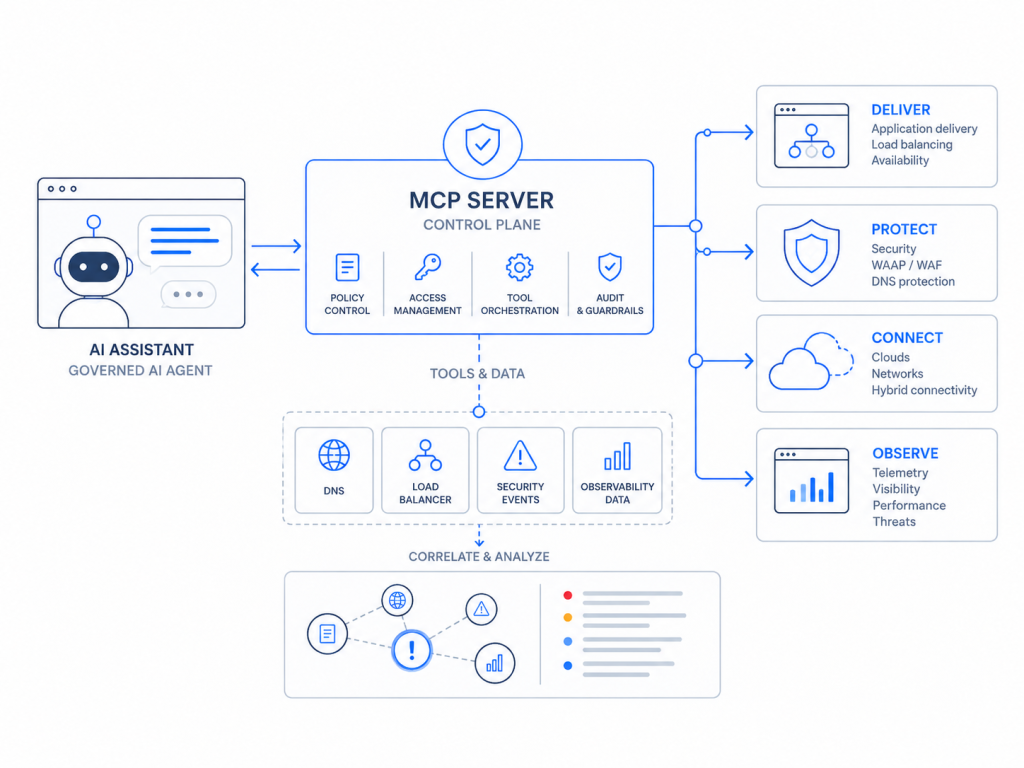
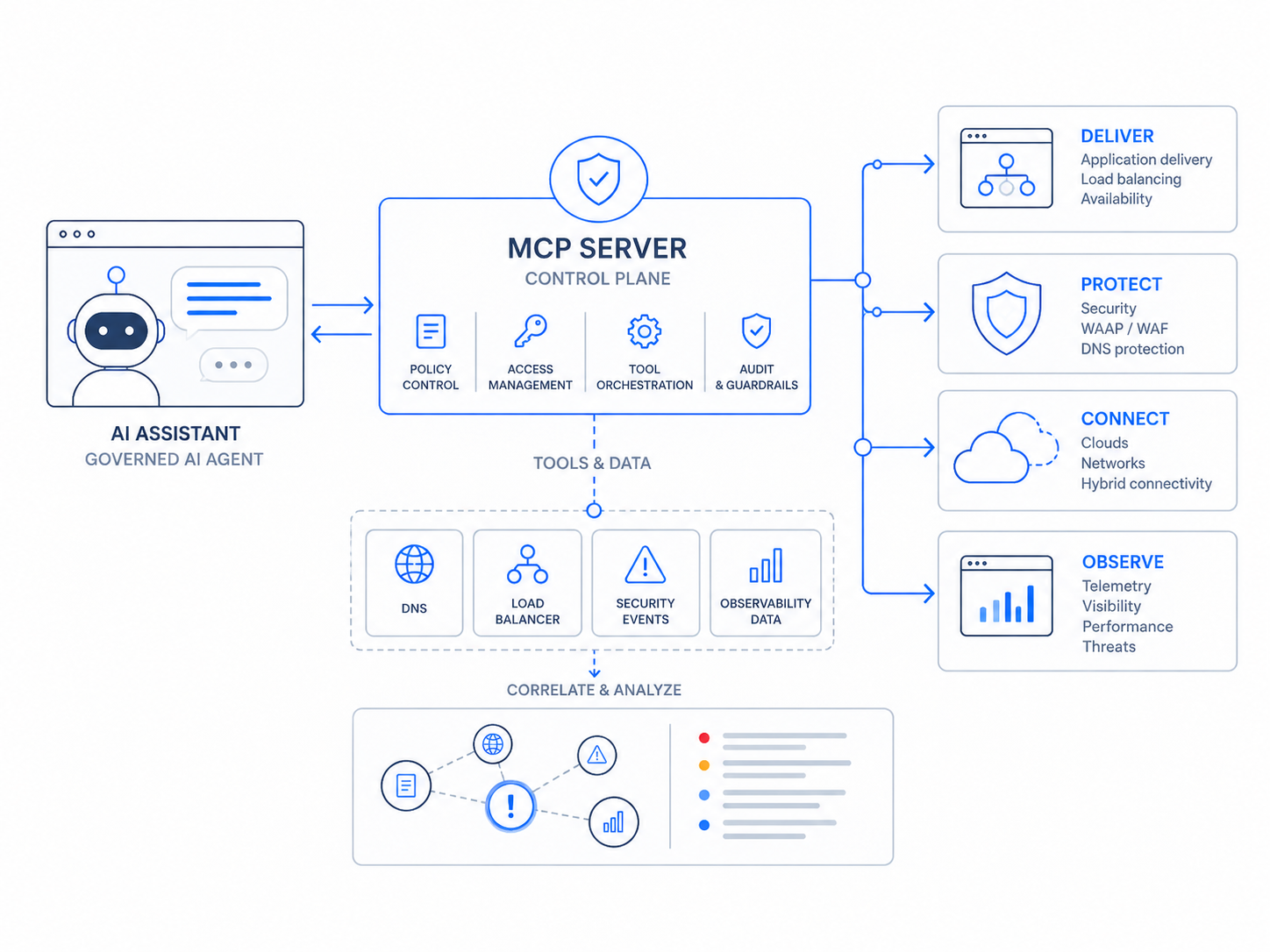
An MCP server exposes defined capabilities that an AI client can request to use. For example, these capabilities might allow an authorized AI assistant to retrieve operational information from a load balancer, examine DNS routing details, or review security events.
There is, however, an important distinction that enterprise leaders need to understand. MCP is not an AI model, and it is not a security boundary in itself.
The AI client determines which available tools to request, but the permissions, authentication, and operational controls surrounding those tools must determine what it is actually allowed to access or do.
This distinction matters because connecting AI to business-critical infrastructure introduces responsibilities that extend well beyond the technology itself.
From Asking Questions to Investigating Problems
Let’s return to the example of an application experiencing intermittent failures.
Under a traditional operating model, an engineer might begin by checking the load balancer to see whether backend servers are healthy. The next step might involve reviewing DNS routing information, followed by security logs to determine whether legitimate traffic is being blocked.
If the application is distributed across multiple cloud environments, the investigation could involve several additional systems.
Each step takes time, particularly when different teams are responsible for different parts of the infrastructure.
Now imagine an authorized AI assistant with access to approved operational tools through MCP.
An engineer could ask the assistant to investigate the application’s recent failures. The assistant could retrieve available load-balancer health information, examine DNS routing data, review relevant security events, and compare timestamps to identify potential relationships.
Rather than presenting disconnected information from several systems, it could bring the evidence together and suggest where the engineer should investigate next.
For example, it might identify that a period of application failures coincided with changes in backend server health or an increase in blocked requests.
That doesn’t necessarily mean it has identified the root cause. Correlation is not proof, and AI-generated explanations can be wrong.
The value lies in helping engineers narrow the investigation, distinguish confirmed facts from possible causes, and make better-informed decisions.
Importantly, the first step toward this operating model should focus on read-only access and investigation, rather than allowing AI to make automatic changes to production infrastructure.
Connecting the Different Parts of Application Delivery
One of the persistent challenges in enterprise IT is that infrastructure is often managed in separate operational domains, even though those domains all contribute to the same business outcome.
An application might be performing poorly because of an issue with traffic distribution, network connectivity, DNS resolution, or security controls. From the user’s perspective, the underlying cause makes little difference. The application either works as expected or it doesn’t.
At Total Uptime, we approach application delivery through four connected capabilities:
DELIVER: Keeping applications available and performing.
PROTECT: Protecting applications, APIs, and DNS.
CONNECT: Connecting applications, cloud environments, and networks.
OBSERVE: Providing visibility into application performance, availability, and threats.
These capabilities address different operational requirements, but they are closely connected when it comes to delivering a reliable application experience.
MCP provides an opportunity to make approved tools and information across these domains accessible through a common interface.
For infrastructure teams, that could mean spending less time gathering information from separate systems and more time understanding what the information is telling them.
It could also help organizations establish a more consistent approach to operational investigations, particularly in complex environments where application delivery spans on-premises infrastructure, public cloud platforms, and managed services.
The objective is not to replace the expertise of infrastructure engineers. It is to give them better access to the evidence they need to do their jobs.
Why AI Access to Production Infrastructure Needs Careful Governance
Giving AI the ability to investigate operational systems is one thing. Allowing it to make changes to those systems is another matter entirely.
While the potential benefits of AI-driven operations are significant, organizations should resist the temptation to move directly from assistance to full automation.
A more practical approach is to introduce these capabilities gradually.
The first stage is observation and explanation. AI can retrieve approved information, compare operational data, and help engineers understand what may be happening. At this point, access should generally remain read-only.
The second stage is evidence-based recommendations. Once organizations have established confidence in the quality of the information and the reliability of the outputs, AI can begin suggesting specific operational actions. Engineers can review the evidence and decide whether those recommendations are appropriate.
The third stage is controlled execution. AI agents may eventually be permitted to carry out narrowly defined workflows, but only where the necessary permissions, approvals, and safeguards are in place.
Throughout this progression, organizations need to address identity management, least-privilege access, auditability, approval requirements, and rollback procedures.
They also need to recognize that information returned by external tools may be incomplete, inaccurate, or manipulated. Simply because an AI agent has retrieved information from an operational system does not mean that every conclusion it draws from that information is correct.
An AI recommendation should never automatically become an unrestricted production command.
For enterprise leaders, the question is not simply whether AI can perform a particular task. It is whether that task can be performed safely, consistently, and with appropriate accountability.
Measuring Whether AI Is Actually Improving Operations
As organizations begin exploring AI agents and MCP, it will be tempting to measure success by the number of integrations deployed, tools connected, or tasks performed by an agent.
Those metrics may demonstrate activity, but they don’t necessarily demonstrate business value.
The real question is whether these capabilities improve the way applications and infrastructure are managed.
For example, is the organization identifying the causes of incidents more quickly? Are engineers spending less time collecting evidence across multiple systems? Is the average time required to restore services improving?
There are several meaningful measures worth tracking, including time to diagnose incidents, mean time to restore service, engineering effort, change failure rates, and audit completeness.
A sensible approach is to establish a baseline before introducing AI-assisted operations, run a limited pilot, and then compare the results.
If the pilot demonstrates measurable improvements, the organization can consider expanding the available capabilities and permissions.
If it doesn’t, the priority should be understanding why, rather than simply giving the AI agent access to more systems.
Ultimately, the value of AI in infrastructure operations should be measured by better operational outcomes, not by how much AI an organization is using.
The Bigger Opportunity for Enterprise Infrastructure
MCP is an important development because it provides a more consistent way for AI applications to interact with operational tools and data.
But the technology itself is only part of the story.
The greater opportunity lies in connecting the information that infrastructure teams already rely on, making that information easier to investigate, and helping engineers make decisions with a more complete understanding of what is happening across their application environments.
As organizations become increasingly dependent on applications that span multiple clouds, networks, security services, and delivery platforms, the ability to connect operational intelligence becomes more valuable.
AI agents could play an important role in that evolution, provided organizations introduce them with the right governance, clearly defined responsibilities, and realistic expectations.
For business and technology leaders, the starting point should be straightforward: identify an operational problem worth solving, give AI access only to the tools and information it needs, and measure whether the outcome improves.
The goal isn’t to introduce AI simply because the technology is available. It’s to make application operations more effective, strengthen resilience, and help teams respond to problems with greater speed and confidence.
And that is where MCP has the potential to make a meaningful difference.
Explore the Total Uptime MCP Server
Discover how Total Uptime is approaching governed AI connectivity across application delivery and infrastructure operations.