AI Agents Need Guardrails: Building Trustworthy Infrastructure Automation
Why identity, least privilege, policy enforcement, and human accountability must be part of enterprise AI operations from day one.
Giving an AI assistant access to information is one thing. Giving it the ability to make changes to your production infrastructure is something entirely different.
For years, enterprise AI governance has focused largely on data security. What information can an AI assistant access? What might it disclose? How do we prevent sensitive business information from ending up in the wrong hands?
Those questions remain important, but the arrival of AI agents introduces a new level of responsibility. We are no longer dealing exclusively with systems that retrieve information and generate responses. Increasingly, we are connecting AI to tools and infrastructure APIs that allow it to investigate problems, retrieve operational data, and potentially take action.
Imagine an AI agent investigating an application performance issue. It might inspect configurations, analyze telemetry, and identify a possible cause. That is useful. But what happens when the same agent has permission to modify a DNS record, change a firewall rule, or initiate a production failover?
Suddenly, AI governance is no longer just about protecting information. It becomes a question of identity, authorization, operational risk, and accountability.
This is why AI agent governance needs to be designed into infrastructure automation from the beginning, rather than introduced as an afterthought once agents are already operating in production.
MCP Connects the Tools. It Doesn’t Govern Them.
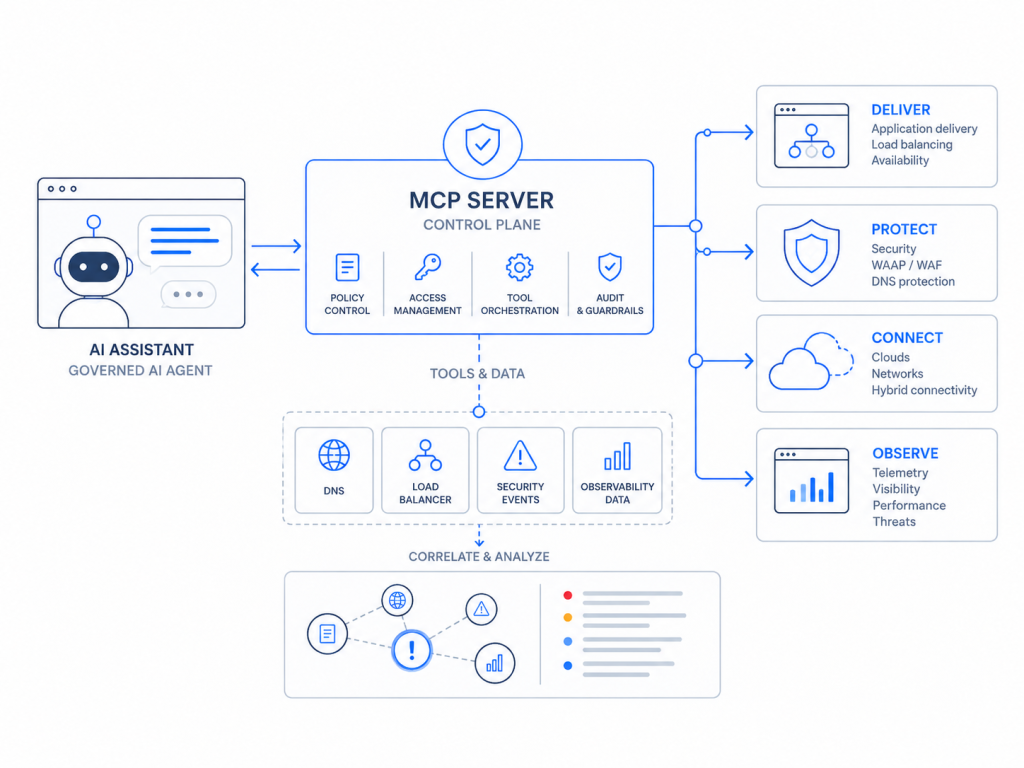
The Model Context Protocol (MCP) is opening up new possibilities for AI-driven infrastructure operations by providing a standardized way for AI clients to discover and interact with tools.
That standardization is valuable. Instead of relying on individual integrations for every application or infrastructure service, organizations can use a more consistent approach to connecting AI systems with the tools they need.
However, there is an important distinction between giving an AI agent access to a tool and giving it permission to use that tool in a particular way.
MCP provides a mechanism for discovering and invoking tools. It does not automatically make those tools safe, guarantee that every user has been authenticated correctly, or prevent an agent from performing a potentially damaging operation.
Those responsibilities remain with the organization deploying the technology.
This means establishing clear trust boundaries between the user, the AI client, the MCP server, and the infrastructure systems being accessed. Every request must be evaluated against the permissions and policies that apply to the person, agent, and environment involved.
An AI agent should never gain access to a privileged operation simply because it can formulate a convincing request.
Start With Identity and Least Privilege
Most infrastructure security teams are already familiar with the principle of least privilege. Users and systems should have access only to the resources and functions they genuinely need.
The same principle applies to AI agents.
Before an agent is allowed to interact with infrastructure, organizations need to establish a verifiable identity and define the operational role under which it is acting. Permissions should be tied to that identity and limited according to the tasks the agent is authorized to perform.
For example, an AI agent responsible for investigating application availability issues might need permission to retrieve health-check results, inspect configurations, and review performance telemetry. None of those responsibilities automatically justifies permission to change production settings.
Read-only investigation and configuration-changing operations should therefore be treated as separate levels of access.
Permissions should also be restricted by environment, tenant, resource, and function. An agent authorized to examine a development environment should not automatically have equivalent access to production. Similarly, access granted for one customer or tenant should not extend to another.
Where possible, organizations should use short-lived credentials and avoid placing privileged secrets in prompts, model context, or logs.
Service accounts deserve particular attention. They can easily become a convenient way to connect automation with infrastructure, but they must not become invisible superusers operating outside the normal controls applied to human administrators.
The objective is to make AI access as deliberate, traceable, and restricted as any other form of privileged access.
Treat Tool Output as Untrusted Information
One of the less obvious risks in AI infrastructure automation is that the information an agent retrieves may itself contain malicious instructions.
Consider the variety of information an infrastructure agent might encounter during a routine investigation. It could review application logs, support tickets, configuration descriptions, monitoring data, or external web pages.
Some of that information may contain text controlled by an attacker.
This creates an opportunity for prompt injection, where malicious content attempts to influence the behavior of the AI system. Instead of simply presenting information for analysis, the content may instruct the agent to ignore previous directions, disclose sensitive information, or invoke tools in ways that were never intended.
The challenge is that the agent may encounter these instructions while performing an entirely legitimate task.
Organizations cannot solve this problem simply by asking the AI model to be more careful. The safeguards need to exist in the underlying architecture.
Untrusted information must be kept separate from trusted instructions. Tool arguments should be validated, accessible operations should be restricted, and independent policy checks should determine whether an action is authorized.
Most importantly, an agent’s confidence in its own recommendation should never be treated as evidence that it has permission to act.
This is a fundamental requirement for secure AI infrastructure automation, particularly when agents are connected to systems that influence application availability, network connectivity, or security policies.
Keep Humans Involved Where the Risk Justifies It
The appeal of AI agents is understandable. If an intelligent system can identify an operational problem and determine the next step, why not allow it to resolve the issue automatically?
In some situations, that will make perfect sense. Routine, low-risk operations are natural candidates for automation, particularly when their behavior is predictable and the outcomes can be verified.
However, not every infrastructure decision carries the same level of risk.
A production failover, DNS modification, firewall policy change, or certificate operation can affect far more than the individual system being investigated. Depending on the environment, the consequences of an incorrect action may extend across applications, customers, or entire services.
These actions require a different level of oversight.
High-impact operations should be subject to explicit approval, appropriate validation before changes are made, documented change records, and a defined rollback plan.
That does not mean every AI-assisted operation needs a human administrator to approve it. It means organizations should establish risk-based controls that determine when human intervention is necessary.
As lower-risk automation demonstrates consistent safety and reliability, its scope can be expanded progressively.
The goal should be to give AI agents greater operational autonomy where there is evidence that they can operate safely, while retaining human accountability for decisions that could have significant consequences.
Audit the Entire Decision, Not Just the Outcome
When an administrator makes a change to production infrastructure, organizations generally expect to be able to determine who made the change, why it happened, and what the result was.
AI-driven operations should be held to the same standard.
An effective audit trail needs to capture the full sequence of events, beginning with the person or system that initiated the request.
It should record which tools were invoked, the parameters submitted to those tools, any approvals that were granted, the changes that were made, and the results of subsequent verification checks.
This level of visibility becomes particularly important when an AI agent interacts with multiple tools during a single task. Without a clear record of the decision chain, investigating an unexpected outcome can become extremely difficult.
There is also a balance to maintain. Audit logs need to provide sufficient information for accountability and incident investigation without unnecessarily exposing credentials, sensitive configuration details, or customer information.
Governance therefore cannot stop at the AI model or the MCP connection. It needs to extend across the agent, the connector, and the underlying infrastructure APIs.
If an organization cannot explain what an agent did, under whose authority it acted, and whether the intended outcome was achieved, it does not yet have the level of control required for trustworthy enterprise automation.
AI Governance Is an Operating Model, Not Just a Security Policy
For executive teams, the introduction of AI agents into infrastructure operations should be approached as an operational governance decision, not simply another technology deployment.
The responsibilities need to be clear from the outset.
Security teams, platform engineering, risk management, and operations all have a role to play in determining which activities agents may perform, what controls apply, and how exceptions or incidents should be handled.
A practical governance model should establish an approved catalog of AI use cases, classify tools according to operational risk, define appropriate authorization and approval requirements, and document escalation procedures.
It should also include periodic reviews of how agents are performing and whether their permissions remain appropriate.
At a technical level, the operating model should connect verified user and agent identities with controlled MCP tool access. Independent policy checks determine which operations are permitted, approvals are applied where necessary, and audit records and post-action verification provide evidence of what occurred.
The exact controls and integrations will depend on the deployment, but the underlying principles should remain consistent.
For organizations beginning this journey, a read-only pilot is often the most sensible starting point.
Allow an agent to inspect infrastructure, gather operational information, and assist with investigations before introducing permissions that could affect production systems. Use the results of that pilot to evaluate reliability, identify risks, and determine whether broader automation is justified.
This approach gives organizations an opportunity to build confidence in the technology without exposing critical infrastructure to unnecessary risk.
It also creates a more defensible path toward greater autonomy, supported by operational evidence rather than assumptions about what AI should be capable of doing.
The Strategic Takeaway: Trust Must Be Built Into Automation
AI agents have the potential to change how enterprise infrastructure is operated. They can help teams investigate issues, retrieve information across different systems, and support more efficient operational workflows.
But the ability to perform an action should never be confused with the authority to perform it.
Many of the controls needed to make AI infrastructure automation trustworthy are not new. Identity management, least privilege, separation of duties, change management, and auditability have been central to enterprise security for decades.
What is changing is the way those controls need to be applied when software agents begin interacting with infrastructure on behalf of people.
MCP can provide the connection between AI systems and operational tools. Governance determines how those connections can be used responsibly.
For organizations looking to introduce AI into critical infrastructure operations, the priority should not be to automate everything as quickly as possible. It should be to establish a foundation that makes increasing levels of automation safe, accountable, and sustainable.
The real measure of successful AI infrastructure automation is not simply what an agent can do, but whether the organization can trust and control what it does.
Explore the Total Uptime MCP Server
Discover how Total Uptime is approaching governed AI connectivity across application delivery and infrastructure operations.