SOC 2 Type 2 and Operational Resilience: Why Independent Assurance Matters
Every infrastructure provider can say its platform is secure, resilient, and ready for the enterprise. The harder question is whether the controls behind those claims have been independently examined and shown to work consistently over time.
For organizations running payment systems, customer-facing applications, regulated workloads, or other mission-critical services, that distinction matters.
SOC 2 Type 2 is often viewed primarily as a compliance requirement. But its real value goes further. It provides independent evidence that the controls designed to protect critical systems are not simply documented. They have been evaluated to determine whether they operate effectively over a defined period.
For businesses that depend on application availability, security, and resilient infrastructure, that evidence matters.
What does SOC 2 Type 2 actually tell you?
SOC 2 was developed by the American Institute of Certified Public Accountants (AICPA) as a framework for examining controls at service organizations.
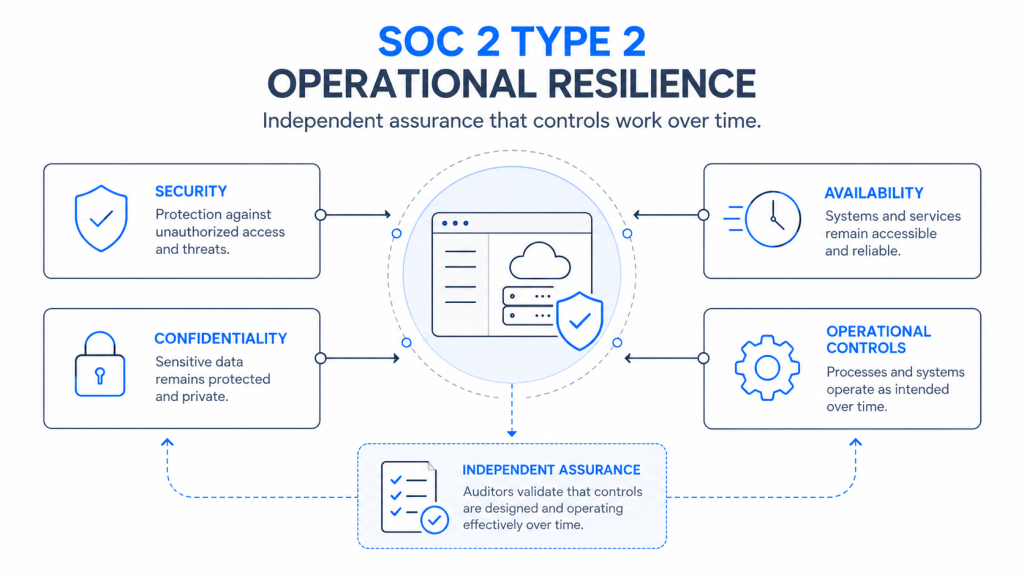
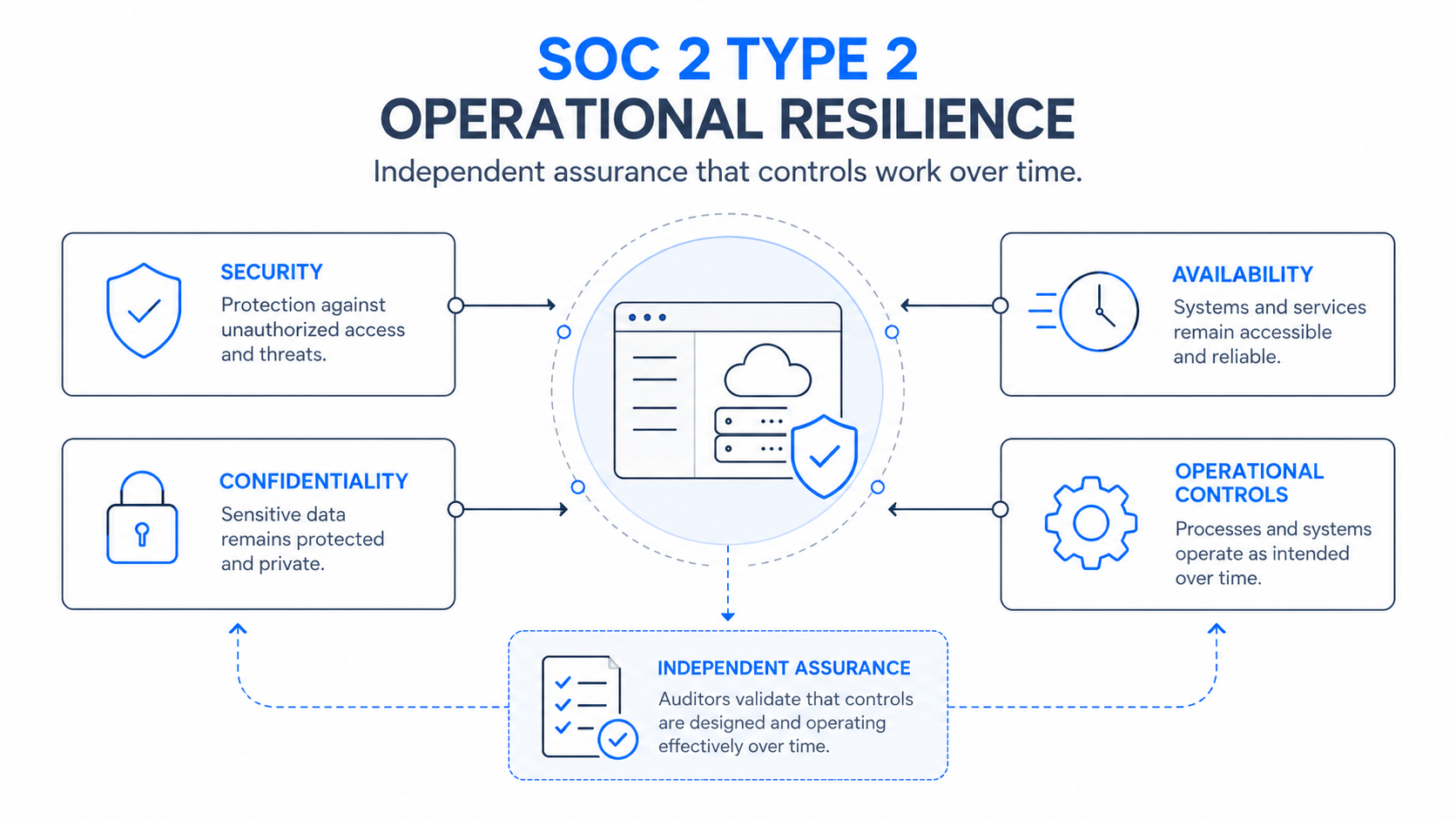
A SOC 2 Type 2 examination looks at both the design of relevant controls and how effectively those controls operate over an observation period. That is an important distinction.
A policy can exist on paper. A control can be documented. The more important question is whether that control performs as intended when it is actually needed.
For Total Uptime, three areas are particularly relevant:
1. Security: Controls designed to protect systems, services, and data.
2. Availability: Controls that support dependable and resilient service operation.
3. Confidentiality: Controls governing the protection of confidential information.
These areas are closely connected to the infrastructure responsible for keeping applications available and protected.
From compliance to assurance
There is a meaningful difference between compliance and assurance.
Compliance can sometimes become a checklist exercise. A requirement exists, documentation is created, and the box is checked.
Assurance asks a different question: Do the controls actually work as intended under real operating conditions?
For technical environments, that is much closer to engineering validation.
It is also worth being precise about the terminology. SOC 2 Type 2 is an attestation rather than a certification in the same sense as an ISO certification.
Total Uptime publicly announced its first SOC 2 Type 2 attestation in 2017 and its sixth consecutive attestation in 2022. Total Uptime also identifies its operations and global data center infrastructure as SOC 2 Type 2 audited.
That history matters, but the larger point is not simply that an audit took place. The value comes from independent examination of the controls supporting the services customers rely on.
Availability is also a security concern
Security and availability are often treated as separate disciplines.
Security teams focus on attacks, unauthorized access, and protecting data. Infrastructure teams focus on uptime, routing, connectivity, and system failures.
The user sees something much simpler.
Can I access the application, and can I trust it?
A successful cyberattack can make an application unavailable. So can a DNS failure, routing problem, infrastructure outage, or connectivity issue. The root cause may be different, but the business experiences the same result: disruption.
This is why operational resilience needs to consider security, availability, connectivity, and observability as parts of the same system.
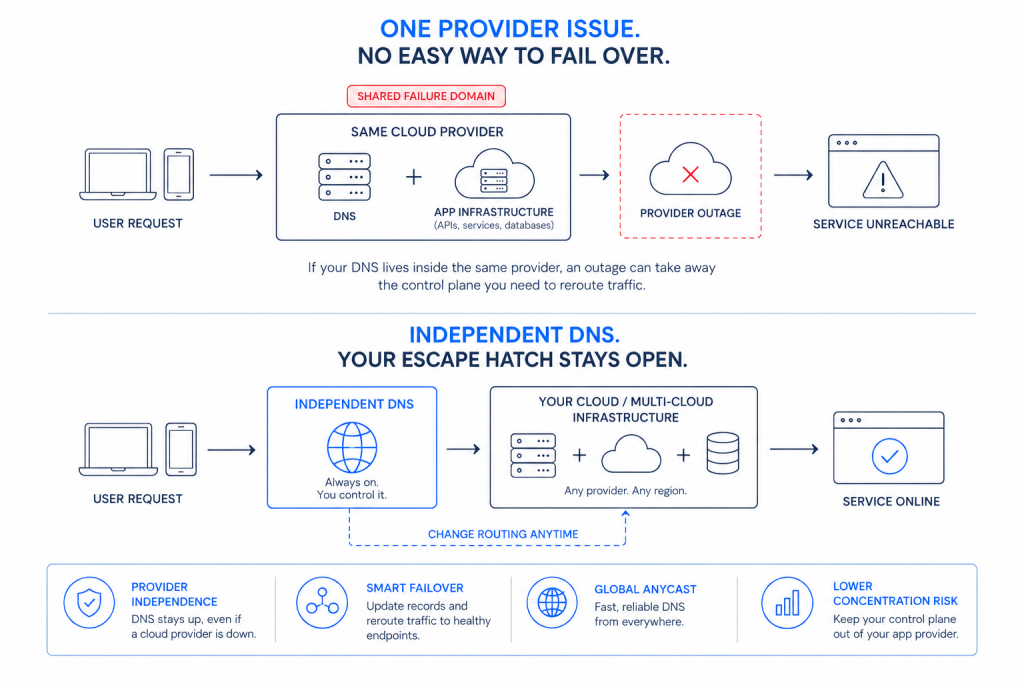
Protecting an application is not only about preventing unauthorized access. It is also about making sure the application remains available when infrastructure fails, traffic patterns change, an upstream provider experiences an outage, or another part of the delivery chain stops working.
Resilience is an engineering discipline
A useful way to think about resilience is to ask three questions.
Infrastructure engineering asks: What happens when something fails?
Security engineering asks: What happens when something is compromised?
Operational governance asks: Can we demonstrate that the controls designed to manage those risks work consistently?
That third question becomes increasingly important as application architectures grow more complex.
Applications may now depend on multiple data centers, public cloud platforms, SaaS services, APIs, edge locations, networks, and third-party infrastructure. AI workloads can introduce even more dependencies.
Every additional dependency creates another potential failure domain.
Resilience therefore comes from the interaction between architecture, security, operational controls, and people.
Architecture + Security + Operational Controls + People = Operational Resilience
Compliance evidence supports that equation, but it cannot replace any of those components.
Why SOC 2 Type 2 matters in the Total Uptime environment
For an application delivery provider, operational assurance has very practical relevance.
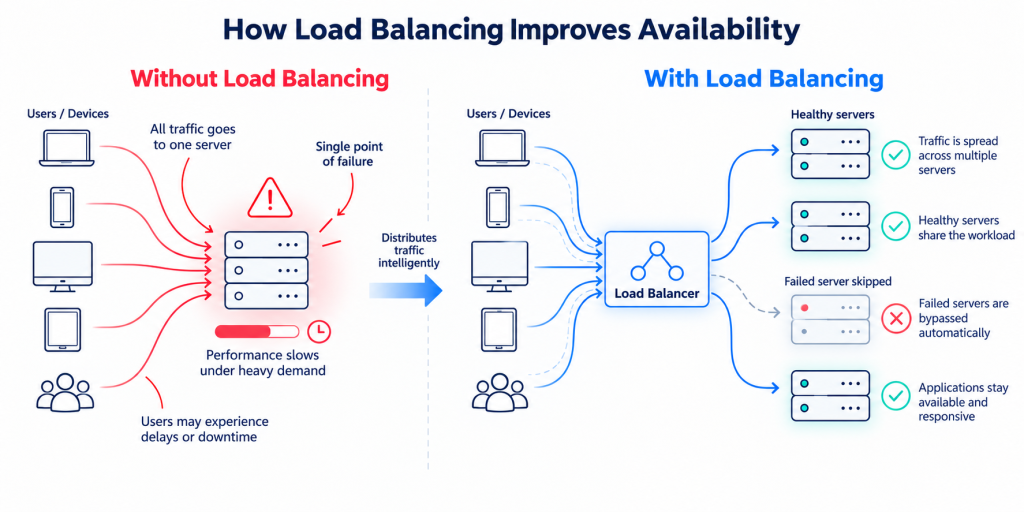
The platform sits directly in the path of production applications and services. Total Uptime capabilities include global DNS, load balancing, Global Server Load Balancing (GSLB), web application protection, DDoS protection, and multicloud networking.
These technologies help organizations keep applications available and protected across distributed cloud, on-premises, and hybrid environments.
That makes operational discipline particularly important.
A SOC 2 Type 2 attestation does not mean an architecture can never fail. It does not guarantee that an organization can never experience a cyberattack or outage.
What it does provide is independent evidence that relevant controls have been evaluated for their operating effectiveness over time.
For regulated businesses, financial institutions, public-sector organizations, and security-conscious enterprises, that evidence can help reduce uncertainty when assessing a technology provider.
Instead of relying exclusively on vendor claims, security, compliance, and procurement teams have independent assurance to include in their risk assessment.
Compliance should be the starting point, not the finish line
An audit report cannot route traffic around an outage. It cannot stop a DDoS attack on its own, and it cannot restore an application at 2:00 a.m.
Those outcomes depend on good architecture, security engineering, operational controls, monitoring, and experienced people.
That is why compliance should be viewed as the foundation rather than the entire resilience strategy.
The real value of SOC 2 Type 2 is not the badge displayed on a website. It is the independent evidence that operational discipline exists behind the technology.
For organizations trusting a provider with critical application infrastructure, that distinction matters.