Build a private network mesh between clouds, offices and data centres.

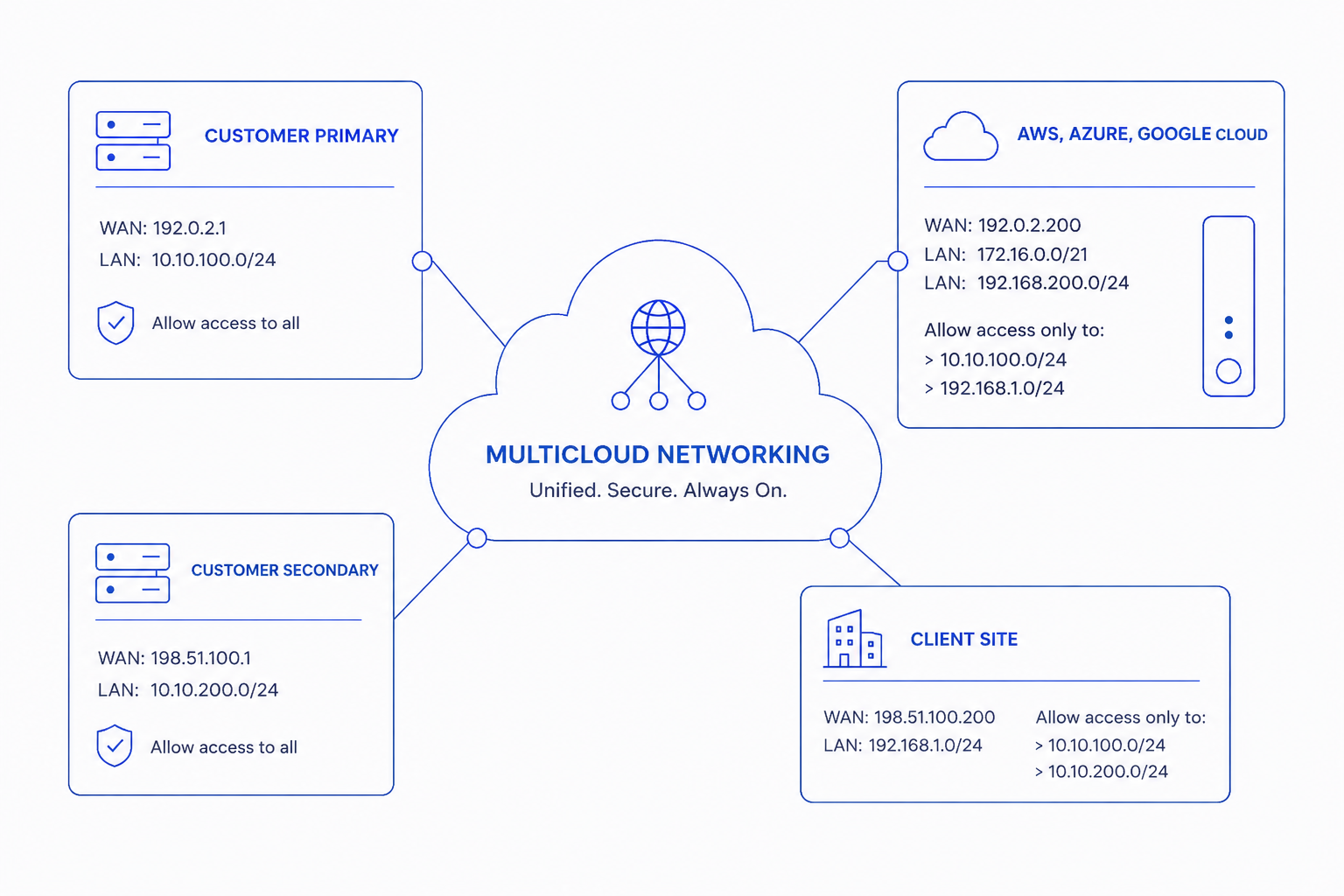
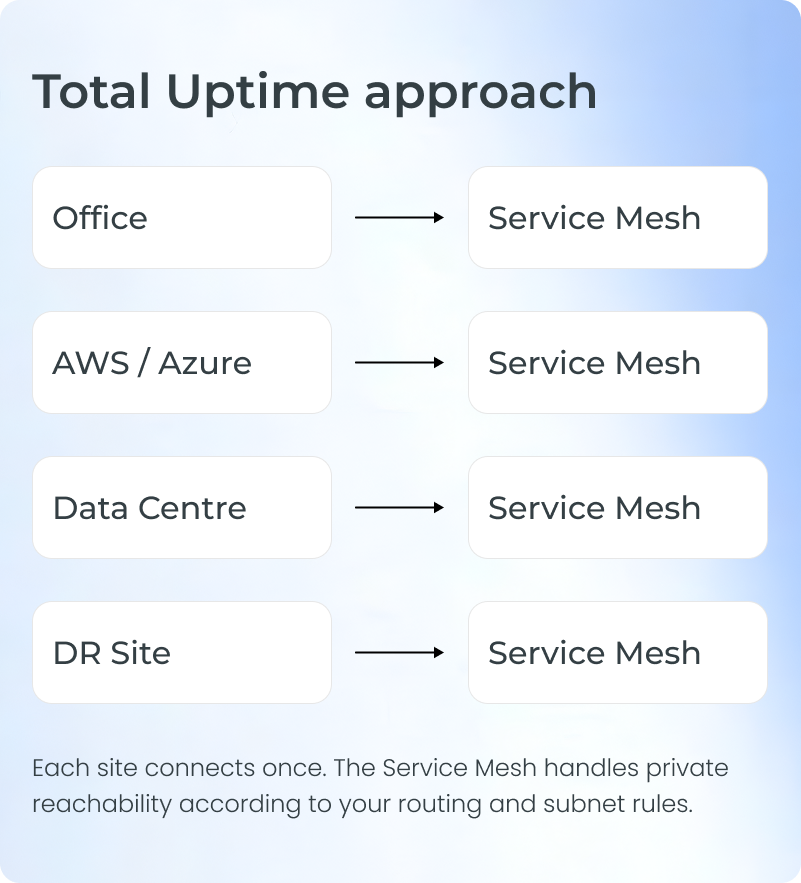
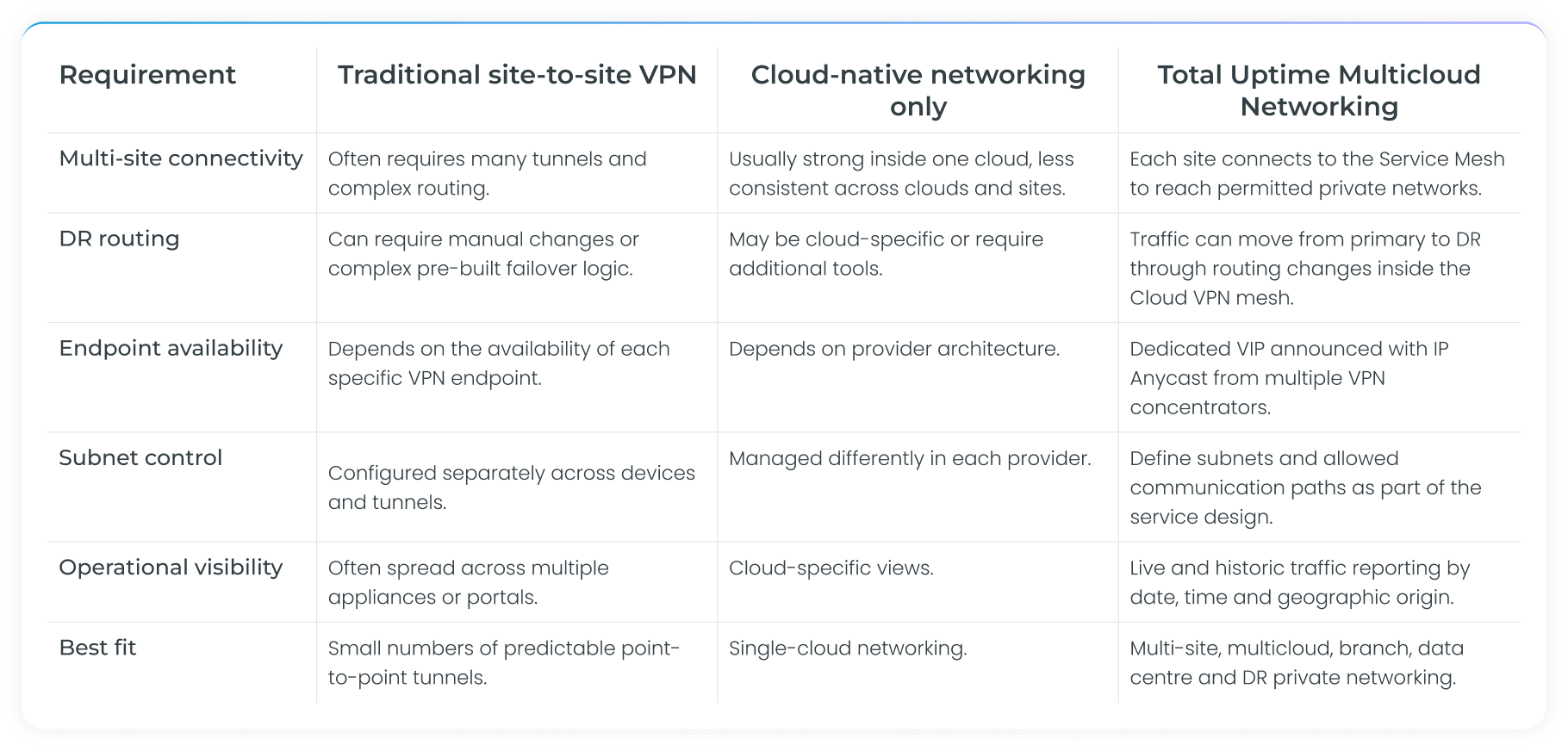
Total Uptime Multicloud Networking simplifies multi-site connectivity by giving each site one tunnel into our globally distributed Service Mesh. Connect primary sites, DR locations, cloud environments and branch offices without building and maintaining a complex full mesh yourself.
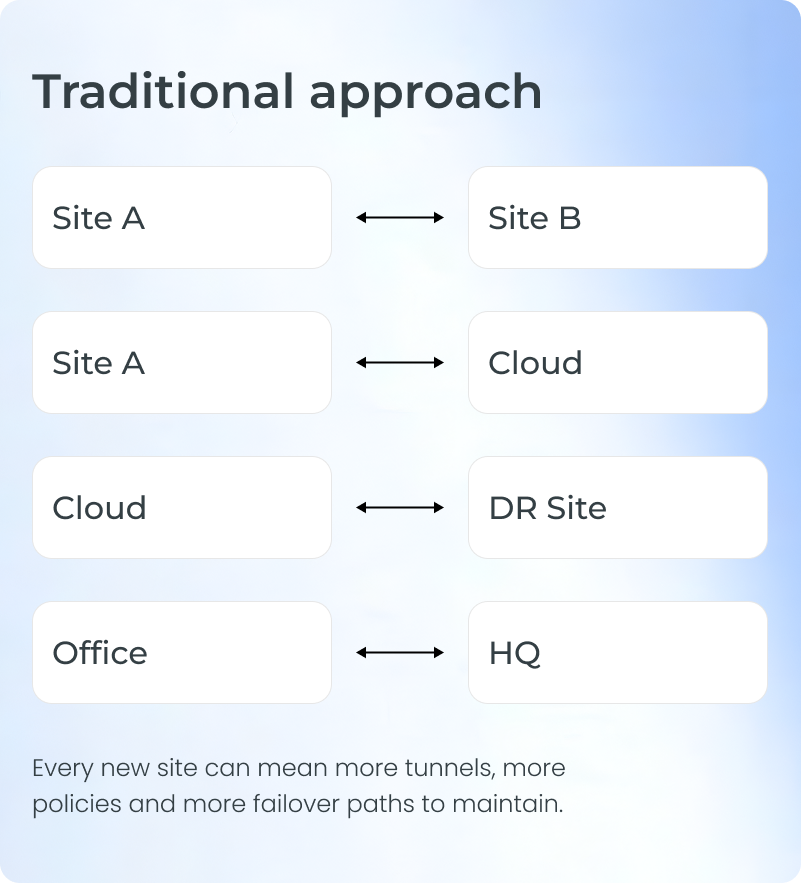
Dozens of tunnels. Multiple appliances. Complex failover.


Point-to-point IPSEC VPNs and traditional SD-WAN designs often require known static IP addresses on both sides. As the number of sites grows, the network can become difficult to configure, monitor and protect.
Disaster recovery makes this even harder. When a primary site fails, every dependent location still needs to reach the right destination without manual changes, downtime or tunnel renegotiation.
Connect everything everywhere without building everything yourself.
Each firewall, VPN endpoint or connectivity device builds a tunnel to a static Virtual IP assigned exclusively to you. That VIP is announced using IP Anycast from multiple VPN concentrators around the world for high redundancy and availability.
You define which subnets exist at each site and which subnets are allowed to communicate. You can permit specific traffic flows or allow all private subnets to communicate with each other.
Use Total Uptime Multicloud Networking to connect clouds, branches, offices, data centres and disaster recovery sites while keeping control over routing, failover and permitted communication paths.
Create secure private connectivity between sites and cloud environments through the Total Uptime Service Mesh.
Build private connectivity over Total Uptime’s purpose-built performance-based MPLS network.
Use a dedicated static VIP announced from multiple VPN concentrators for resilient global tunnel access.
Control which networks can communicate, from strict site-to-site permissions to broader private network reachability.
Use multiple ISPs, firewalls or tunnels at a location and run them active/passive or load balanced.
Monitor live and historic traffic data with graphical reporting by date, time and geographic origin.
Fail over without renegotiating every tunnel.
If a site has two ISPs, two firewalls or multiple tunnels, Total Uptime can load balance inbound traffic or run active/passive. When one ISP, firewall or tunnel fails, traffic can continue over the alternate path.
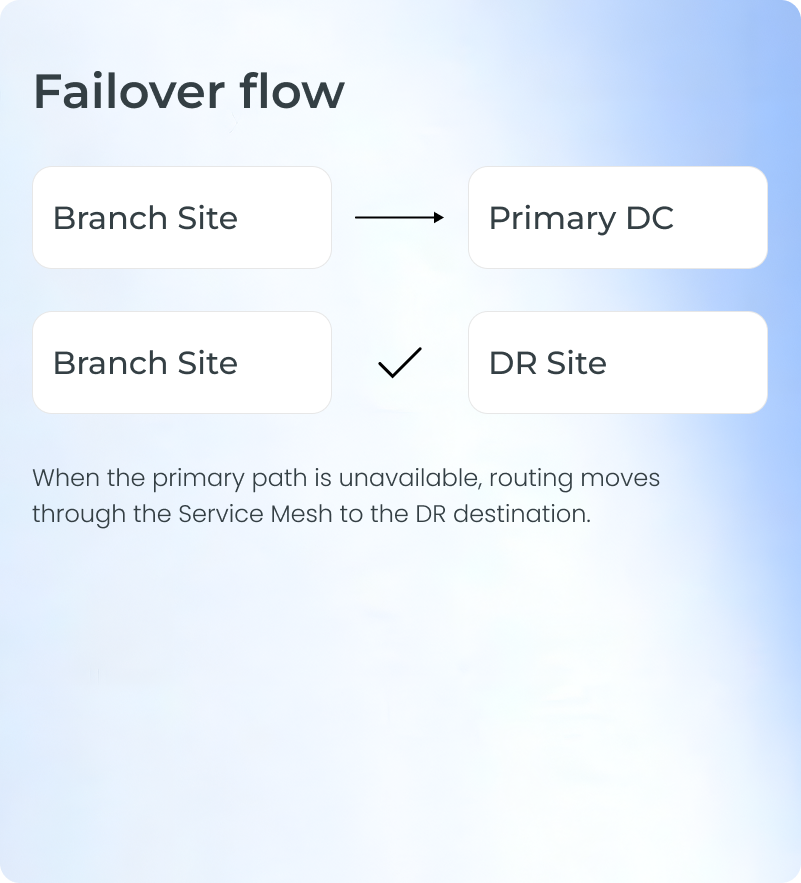
For disaster recovery, traffic that normally goes to a primary VPN at headquarters or a data centre can automatically move to a DR site when the primary site is unavailable. The routing change happens inside the Cloud VPN mesh, without requiring every tunnel to be rebuilt.
This page should attract buyers who are trying to simplify private connectivity and avoid brittle, manually managed VPN meshes.
Privately connect workloads or networks across public cloud providers without relying only on each cloud’s native tooling.
Connect branch offices and corporate locations to cloud-hosted systems through one simplified private network architecture.
Route site traffic to a primary data centre during normal operation and redirect to DR when the primary location is unavailable.
Replace complex full-mesh VPN designs with a model where each site only needs to connect to the Service Mesh.
Use multiple ISP, firewall or tunnel paths to improve availability at important locations.
Define which private networks can talk to each other so connectivity is controlled, intentional and easier to audit.
A cleaner alternative for teams that do not want to manually design, operate and troubleshoot a complex multi-site VPN topology.
When private connectivity matters, you need more than a portal. Total Uptime provides 24×7 support by phone, email or chat from knowledgeable engineers who understand the platform.
“Total Uptime immediately understood our needs and implemented a solution that was exactly what Marcus Evans was looking for.” – Martin Leedham, CIO, Marcus Evans Group
Schedule a no-pitch technical demo with a Total Uptime engineer and walk through your current cloud, office, data centre and DR connectivity challenges.