Looking for an alternative to Imperva?

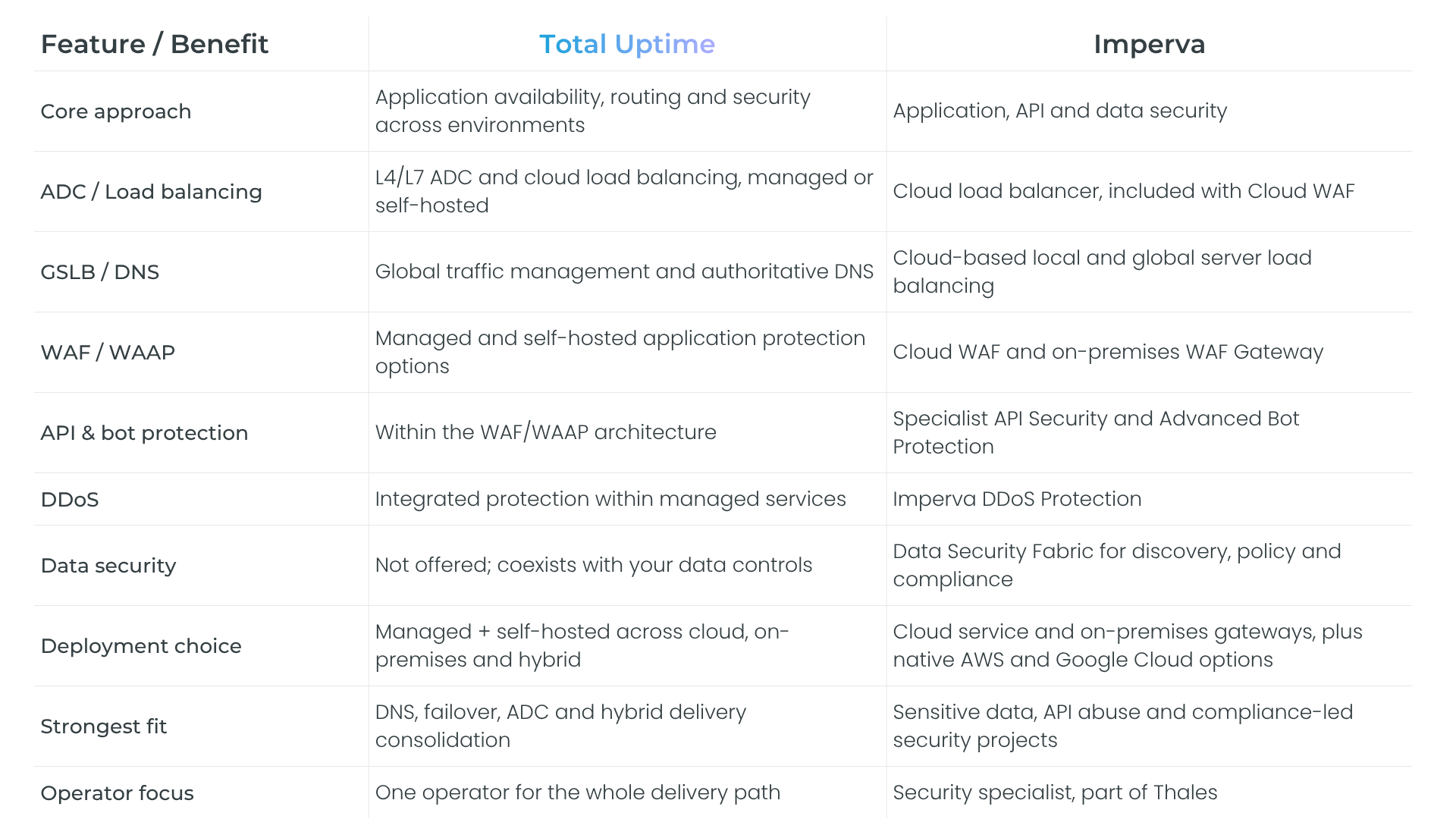
Imperva is a specialist in application, API and data security. Total Uptime approaches the problem from the availability side: keeping the full delivery path working together, including when something fails. As an Imperva alternative for DNS, routing and application delivery, or a partner to your existing security, Total Uptime brings DNS, GSLB, ADC and WAF under one operator.

Total-Uptime-vs-Imperva-Comparison

Imperva protects the application.
Who keeps it available?

The Imperva way

Imperva is strongest in specialist application and API protection and data security. Its Data Security Fabric extends to sensitive-data discovery, policy and compliance, well beyond a WAF.

The Total Uptime way

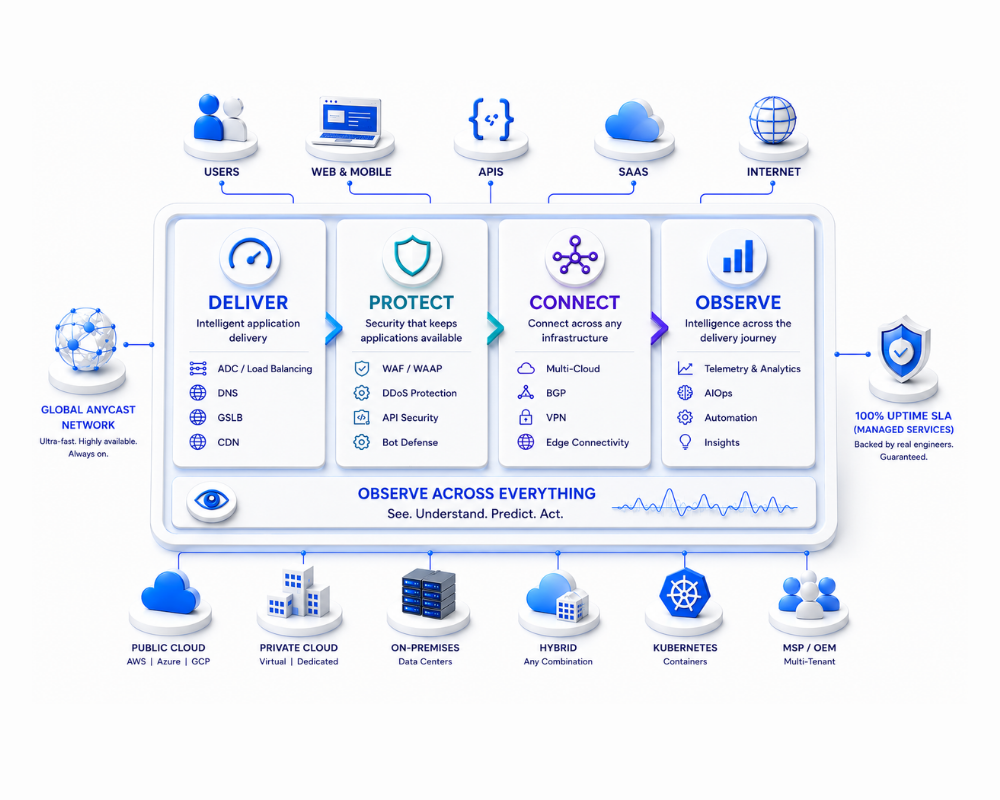
Total Uptime puts the full delivery path under one operator: authoritative DNS, global traffic steering, local and cloud ADC, WAF and resilient connectivity. It is an availability and operations choice, designed to coexist with dedicated data security.

The goal isn’t to replace your security stack. It’s to keep the delivery path around it working, including when something fails.

Imperva alternative or addition?
Two different approaches

When outages come from DNS and routing, not just attacks

Security tools stop malicious traffic. The question is what keeps your applications reachable when the cause is an origin, DNS or routing failure.

Keep applications reachable through failure

Coordinate DNS, GSLB and origin failover so users reach healthy infrastructure when a site or cloud fails.

Put the delivery path under one operator

Run DNS, GSLB, ADC and WAF together, instead of stitching the path across separate vendors.

Choose where WAF runs

Run WAF self-hosted, managed, or both, depending on each application’s requirements.

Keep your data security in place

Strengthen delivery around your existing data controls, without replacing them.

Deliver across hybrid environments

Deliver applications consistently across data centers, private infrastructure and public clouds.

Get closer to the engineers

Work directly with application delivery engineers, available 24×7.

One application delivery strategy.
Across every environment.

TU Application Delivery Unified

Start with one availability pain point.

Managed DNS

Move authoritative DNS to a managed global service, so name resolution doesn’t depend on a single site or provider.

DNS & GSLB

Route users by location and health, and fail over automatically between sites, regions and clouds.

Disaster recovery

Redirect users to healthy infrastructure when an application, site or environment fails.

ADC modernization

Modernize local load balancing with physical, virtual, cloud or managed deployment options.

Self-hosted WAF

Protect applications that must stay inside controlled infrastructure, alongside your existing security tools.

Managed application delivery

Move operational responsibility for selected application delivery functions to Total Uptime rather than managing every component internally.

Your infrastructure. Your way.

Total Uptime lets organizations choose how application delivery is deployed based on the workload rather than forcing every application into the same model.

Virtual

Deploy across VMware, Hyper-V, KVM and Nutanix environments.

Physical

EdgeADC appliances for infrastructure requiring dedicated deployment.

Public Cloud

Support application delivery across AWS, Azure and Google Cloud.

Managed Services

Consume ADC, load balancing, DNS, GSLB and security capabilities as managed services.

Hybrid

Combine self-hosted and managed services across cloud and on-premises infrastructure.

MSP / OEM

Support multi-tenant and service-provider application delivery models.

Imperva and Total Uptime can coexist.

We don’t suggest a blanket move from a proven security vendor. Keep Imperva where data security demands it, and add Total Uptime DNS, GSLB and ADC to make the delivery path around it resilient.

Managed DNS

GSLB and failover

Local ADC

Data security

A practical path to resilient delivery

Assess

Identify your primary driver: application security, data security or infrastructure availability.

Map

Lay out your application flow alongside every security control on the path.

Test

Run one failover scenario and one WAF policy test, live.

Confirm API controls

Document the API controls you need and where each is deployed.

Pilot

Start with one availability pain point and compare ownership, recovery time and cost for that workload.

Expand

Extend Total Uptime into additional DNS, application delivery, security and networking requirements.

Is Total Uptime or Imperva right for you?

Imperva may be the better fit if...

– Sensitive-data discovery, database activity monitoring or data compliance are core needs.

– Your evaluation is led by specialist API and bot protection depth.

– Availability, DNS and routing are already well handled elsewhere.

Total Uptime may be the better fit if...

– Outages come from DNS, origin or routing as often as from attacks.

– You want DNS, GSLB, ADC and WAF under one operator.

– You need WAF self-hosted, managed, or both.

– You want to keep existing data security and strengthen delivery around it.

Frequently asked questions

Quick answers to the questions infrastructure teams ask most.

What is the best alternative to Imperva?

It depends on your primary driver. For sensitive-data discovery, data compliance or specialist API and bot protection, Imperva remains a strong choice. When outages come from DNS, origin or routing as often as from attacks, Total Uptime is an Imperva alternative that brings DNS, GSLB, ADC and WAF under one operator.

For a security-led evaluation, it may. Define the attack cases you care about and test both. Total Uptime is strongest when availability, routing and controlled deployment matter as much as protection.

No. Imperva’s data security capabilities are relevant for database and sensitive-data protection, and Total Uptime isn’t a substitute for them. Total Uptime coexists at the delivery layer while your data controls stay in place.

It does. The difference shows in your architecture: managed DNS, local ADC and WAF, global failover and accountable support. Total Uptime demonstrates those workflows rather than comparing checklists.

No. Start with one availability pain point, run an adjacent pilot and compare ownership, recovery time and cost for that workload.

Yes. Total Uptime supports physical and virtual application delivery infrastructure alongside cloud and managed services, including workloads that must remain inside private or regulated environments.

Customer success

Trusted by IT Teams Worldwide

Real organisations. Real resilience. Real results.

Rated by the people who use us.

Keep your security. Make the delivery path resilient.

Imperva can be the right answer for deep data protection. For the application delivery path, let us show how DNS, routing, ADC and WAF work together during a failure. Show us what you run today and we’ll help you see where Total Uptime can improve resilience, without forcing you to start again.